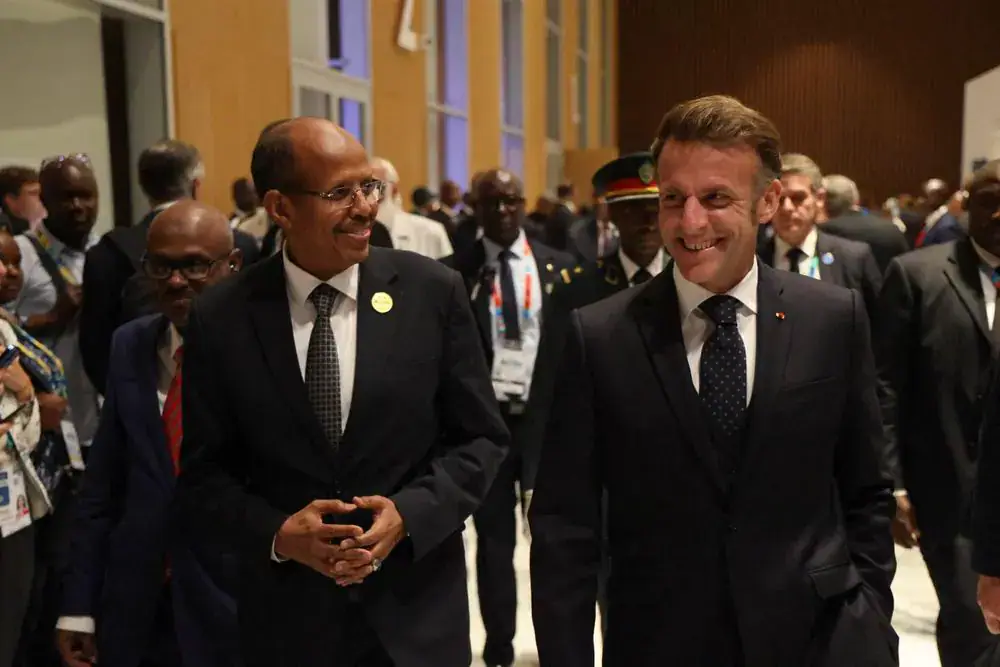
The African Union's dependence on foreign donors is stifling the continent's progress toward sovereignty and self-determination. At a recent meeting in Accra, Ghana, foreign and finance ministers from across the continent discussed the financing of the Union. Despite efforts to increase local funding, the AU still relies heavily on international partners to support its programs and peace and security initiatives. In 2027, member states are expected to fund almost 99% of the AU's operational budget, but only 4% of its program budget and 12% of its peace and security budget.
The AU's approved 2027 budget amounts to approximately $800.1 million, including technical assistance. However, the majority of the Union's program and peace and security expenditure is expected to come from international partners. This institutional dependency is a significant challenge to African sovereignty, as it limits the continent's ability to determine its own priorities and programs without external consultation and conditionality. South Africa's Minister of International Relations and Cooperation, Ronald Lamola, emphasized that unless Africa matches political ownership with financial ownership, its development and integration aspirations will be at risk.
The issue of donor dependency is not new, and it is closely tied to the continent's colonial legacy. According to a report by UNCTAD, close to $88.6 billion leaves Africa annually through illicit capital flight, approximately 3.7% of the continent's GDP. This is a result of colonial patterns that continue to affect the continent, including the extraction of raw materials, foreign beneficiation, and repatriated profits. The continent's limited industrial capacity also reproduces colonial patterns of structural underdevelopment.
African leaders have proposed several solutions to address the issue of donor dependency. At the 2016 Kigali Summit, African leaders endorsed a 0.2% levy on eligible imports as a source of sustainable self-funding for the Union. However, implementation has been slow, and only 18 of the 55 member states have introduced the levy or a comparable domestic mechanism. If fully implemented, it is estimated that this levy could raise $1.2 billion annually, significantly strengthening the AU's finances.
The African Union Commission Chairperson, Mahmoud Ali Youssouf, has proposed a Pact for a More Effective and Results-Oriented African Union for 2027-2029. This pact would center around greater contributions, stronger expenditure controls, and accountability. Ghana's proposed Accra Declaration also contains six commitments that seek to combine financing reform with institutional transformation. These include endorsing the implementation of the 0.2% levy or an equivalent domestic mechanism and adopting an integrated program-based budget and a medium-term expenditure framework.
To achieve financial independence, African governments need to urgently track unpaid contributions and establish solid mechanisms to ensure that financial commitments from member states are honored. The African Union cannot achieve financial independence if member states fail to meet their obligations. Youssouf emphasized that African sovereignty must not merely be proclaimed; it must be built, organized, and financed. This requires a fundamental and structural transformation of African economies so that the wealth generated on the continent contributes directly to African industrialization, employment, and development.
Ultimately, Africa's donor dependency is a complex issue that requires a multifaceted solution. It is not only a matter of funding but also of building a more equitable global economic order. African governments must prioritize industrialization and productive capacity, and the AU must be given the resources and autonomy to determine its own priorities and programs. As Kim Heller, a political analyst, notes, until Africa funds its own institutions on terms it sets, the language of sovereignty will remain little more than another lofty and unfulfilled aspiration.
Key points
- The African Union's reliance on foreign funding undermines its sovereignty and development aspirations.
- The continent's colonial legacy and limited industrial capacity contribute to its donor dependency.
- African leaders have proposed several solutions, including a 0.2% levy on eligible imports and greater contributions from member states.