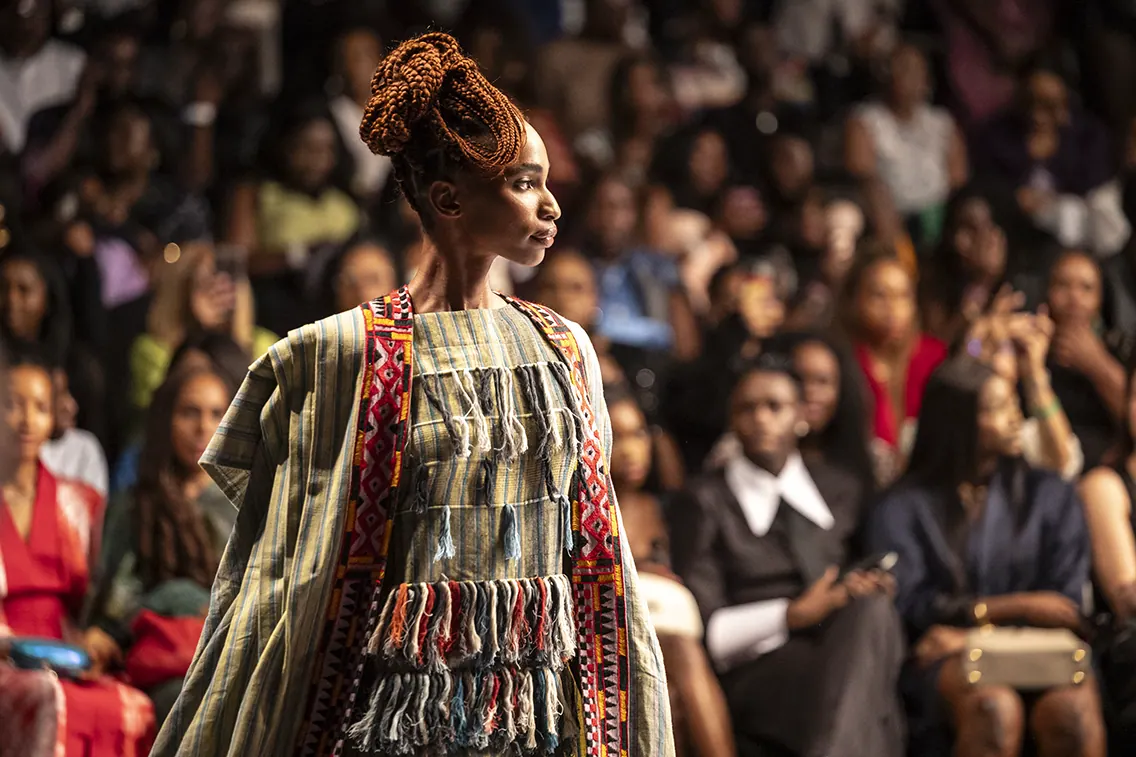
African fashion designers are increasingly headlining fashion weeks worldwide, forging their own paths based on the continent's rich heritage of producing fabrics and styles that are both contemporary and deeply cultural. A new generation of designers is not just creating clothing, but fuelling a textile revolution that combines ethical production and exploration of cultural diversity. Many African designers are familiar with artisan fabrics whose qualities cannot be replicated on an industrial scale.
Nigerian designer Shade Thomas-Fahm, who returned from London's St Martin's School of Art in 1960, began championing traditional fabrics such as aso-oke and adire, originating from the Yoruba people of southwestern Niger. She mentored and inspired generations of African designers who continue to revive ancient crafts and traditions. According to the United Nations University Centre for Policy Research, the clothing industry accounts for around 2% of the world's GDP, but generates 10% of global pollution.
Awa Meité, based in Bamako, Mali, has been ahead of the game, presenting Mali's heritage through her Routes du Sur organisation, established in 1988. She uses a network of artisans across the country to provide materials for her handmade creations. In 2007, she established the Daoula Initiative to buck the trend of Mali's raw cotton being exported rather than processed locally. Her garments are wholly produced in Mali, showcasing the exceptional qualities of traditionally dyed and woven cotton in modern couture.
Meité's work has traversed African borders, appearing on catwalks from Lagos to Paris, and last year achieved a significant milestone with an appearance at Shanghai Fashion Week. Her designs reflect her heritage in an understated manner, allowing the wearer to sense their own story. Meité's approach prioritizes organic growth over expansion, using simple designs that showcase her cultural roots.
Nigerian designers Oromoa Cookey-Gam and Osione Itegboje have combined their expertise to form THIS IS US, a 'Made in Nigeria' brand of contemporary clothing and home textiles. They source Funtua cotton, considered the gold standard of cottons, from Katsina State, where around 60% of Nigeria's cotton is harvested. The brand's products are made from 99% Funtua cotton, with leftover fabric used for merchandise such as patchwork designs and tote bags.
THIS IS US works with local artisans and seamstresses, supporting the local economy and employment while minimizing its carbon footprint. The brand also collaborates with the ancient Kofar Mata Dye Pits in Kanu, which have been at the heart of West Africa's traditional dyeing process for over 500 years. Cookey-Gam and Itegboje have introduced cassava paste into the dyeing process, allowing for precise patterns in addition to traditional indigo tie-and-dye techniques.
Ethiopian designer Fikirte Addis, a self-taught designer and trained child psychologist, launched her label Yefikir Design in 2009. She uses hand-woven traditional Ethiopian cotton, bringing longstanding culture to high-end chic. Addis prioritizes sustainability and fair wages for local weavers and embroiderers, championing a child-free labour workforce. Her designs incorporate distinctive Ethiopian geometric and decorative borders, embedding a deep symbolic visual language into traditional Ethiopian garments.
Key points
- African designers are leading a textile revolution that combines ethical production with cultural diversity.
- Many African designers are using traditional fabrics and techniques to create modern, sustainable clothing.
- The African fashion industry is prioritizing responsible production and cultural heritage over growth and industrialization.