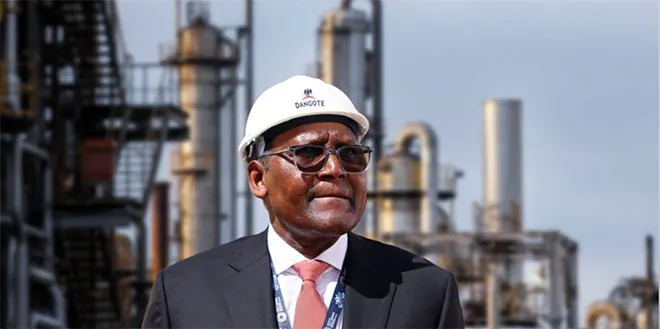
Dangote Refinery's highly anticipated initial public offering (IPO) has opened, offering 4.1 billion shares at ₦525 (about $4) each, targeting ₦2.15 trillion ($1.6 billion). The IPO, which began on September 14, is set to close on October 13, with trading on the Nigerian Exchange expected to start in November. This significant transaction is drawing retail and institutional investors into its ownership, testing whether Africa's fragmented capital markets can finance industrial growth at scale.
The IPO has generated significant interest, with several distributor apps experiencing outages due to high demand. According to Temi Popoola, Group Managing Director and CEO of Nigerian Exchange Group, the disruption was caused by a sharp surge in traffic following the IPO launch. This enthusiasm has also sparked discussions about a potential cross-listing on the Nairobi Securities Exchange, with Kenya's stock exchange pushing to bring African investors into the offer.
A potential Nairobi cross-listing is being considered, with Nairobi Securities Exchange CEO Frank Mwiti stating that it is "on the table." The NSE is discussing the proposal with Dangote, the Nigerian Exchange, and Nigeria's capital-market regulator. This move aims to connect Africa's capital markets and provide a regional opportunity for investors. Kenya is seeking a stake in the regional opportunity, and a cross-listing could pave the way for more African companies to access capital from across the continent.
The Dangote Refinery has reported impressive financial performance, with $13.9 billion in revenue and $1.82 billion in net profit in the first half of 2026. This is a significant improvement compared to a $476 million loss in 2025. The refinery's recent profits raise questions about its valuation, with investors focusing on the durability of those earnings. According to investment analyst Ibinabo Anabraba, investors should consider whether the refinery's recent performance represents a new sustainable earnings base or a favourable refining environment.
At ₦525 (about $4) a share, the offer values the refinery at roughly ₦63 trillion (about $47.6 billion). The valuation implies around 8.3 times projected 2026 EBITDA and depends partly on future expansion and refining conditions. Anabraba argues that investors should look beyond the size of the refinery and ask whether it can generate sufficient returns on the enormous capital invested. The refinery plans to increase capacity from about 700,000 barrels per day to 1.4 million barrels per day by 2029, which will require additional crude supplies, capital expenditure, and operating capacity.
The refinery's significance extends beyond Nigeria, with Dangote supplying about 80,000 barrels of jet fuel per day to Europe in the second quarter of 2026. This makes it Europe's largest supplier of the fuel during a period of disrupted Middle Eastern exports. The refinery also increased diesel and gasoil exports to West Africa and Europe, strengthening the industrialisation argument behind the IPO. According to Popoola, large African companies should be financed by Africans, and the continent needs to mobilise capital to drive collective growth.
The ambition is consistent with discussions already taking place among African exchanges. In April, the Nigerian Exchange brought together the Johannesburg Stock Exchange, Nairobi Securities Exchange, Ghana Stock Exchange, Ethiopian Securities Exchange, and the BRVM for talks with Dangote and Nigerian market officials about cross-border investment. The goal is to structure a pan-African IPO, which could pave the way for more African companies to access capital from across the continent.
Key points
- The Dangote Refinery IPO is testing Africa's capital markets and their ability to finance industrial growth at scale.
- A potential cross-listing on the Nairobi Securities Exchange could provide a regional opportunity for investors and pave the way for more African companies to access capital.
- The refinery's valuation and financial performance raise questions about its sustainability and ability to generate sufficient returns on investment.