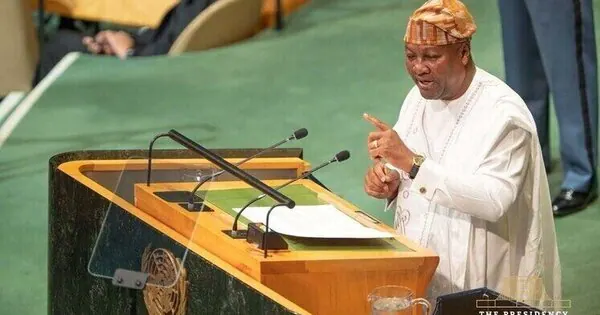
Ghanaian President John Dramani Mahama has told the UN General Assembly that Africa will not accept another era of colonial-style resource extraction as global demand for critical minerals grows. Mahama called for structural reforms to address historical injustices. He emphasized that Africa seeks equal partnership, not charity. The continent holds substantial deposits of critical minerals such as copper, cobalt, and lithium.
The US and EU are pursuing deals with African governments to secure these minerals for electric vehicles, batteries, and power grids. This is part of their effort to reduce reliance on China. However, African countries often export raw minerals, missing out on the value generated by processing and manufacturing. A UN Trade and Development report published in June warned that resource-rich African countries could miss out on this value.
Mahama stated that Africa will not remain a passive arena for a new scramble for resources. He emphasized that African countries must process their minerals at home, build local industries, and retain more of the wealth they generate. Several African governments have moved to tighten control over their mineral resources in recent years. The Democratic Republic of Congo, the world's largest cobalt producer, has banned exports of copper and cobalt concentrates.
Zimbabwe also suspended exports of raw minerals and lithium concentrates in February. Ghana has required licensed aggregators to refine gold locally since September 1. Mahama pledged to end raw mineral ore exports by 2030. Mali created a state body to oversee artisanal gold sales and curb smuggling in July. Niger nationalized the Somair uranium venture operated by French state-owned Orano last year.
Mahama also renewed the call for slavery reparations in his role as the African Union's champion for the campaign. In March, Ghana secured a UN resolution recognizing the transatlantic slave trade and chattel slavery as the gravest crimes against humanity. The resolution passed with 123 votes. The US, Israel, and Argentina voted against it, while 52 countries abstained.
Mahama welcomed what he called "positive overtures" from countries, particularly the Netherlands, Germany, and France, as well as from institutions, on reparatory justice and restitution. However, he said real repair requires "structural transformation," including "dismantling the persistent engines of exploitation: unfair global trade regimes, predatory resource extraction, discriminatory credit ratings, [and] unsustainable debt burdens."
Mahama emphasized that Africa does not seek charity but equal partnership. His remarks reflect the concerns of many African countries about the exploitation of their natural resources. The continent is seeking a fairer deal in the global economy. African countries are taking steps to assert control over their resources and generate more value from them.
Key points
- Africa will not accept another era of colonial-style resource extraction.
- African countries must process their minerals at home and retain more of the wealth they generate.
- Ghana has pledged to end raw mineral ore exports by 2030.