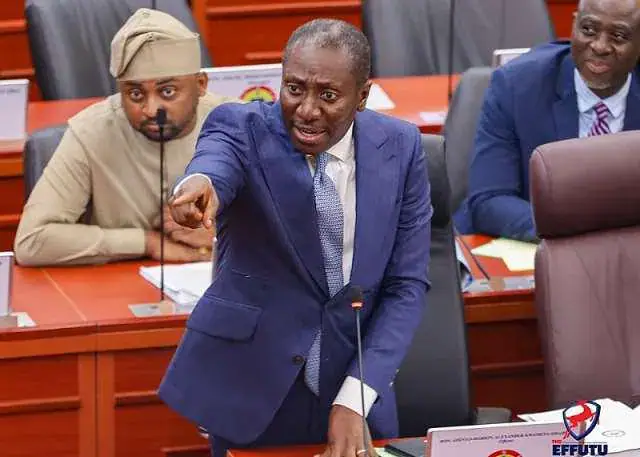
Ghana's Minority Leader Alexander Afenyo Markin has questioned the government's claims of economic progress, arguing that improvements in official statistics have not translated into meaningful financial relief for ordinary Ghanaians, households, and businesses. He made these comments during the concluding debate on the 2027 Budget Statement in Parliament on November 26, 2026. Afenyo Markin emphasized that the economic picture presented by the government seems disconnected from the experiences of ordinary people.
Afenyo Markin drew a distinction between what he described as the government's "paper economy" and the difficult financial circumstances confronting citizens in their everyday lives. He stated that the government's economic narrative is largely reflected in official speeches, public presentations, and social media communications, while the actual financial conditions facing citizens can be better understood through their daily struggles at home, in schools, markets, and commercial establishments.
The Effutu legislator maintained that improvements in macroeconomic indicators would have limited significance if households continued to struggle with the cost of food, education, and other essential necessities. He emphasized that ordinary citizens cannot rely on favourable government announcements or statistical improvements to meet their everyday financial obligations. Afenyo Markin gave examples of how government statements and statistics do not directly impact citizens' daily lives.
Afenyo Markin further challenged the administration to demonstrate how the reported reduction in prices and improvements in economic performance are affecting the purchasing power of households and the operational conditions of small businesses. He questioned whether the economic gains being highlighted by the government are producing tangible benefits for traders, entrepreneurs, and families still confronting financial difficulties.
The government's defence of its economic management has centred on improvements in several key macroeconomic indicators, including a decline in inflation and relative stability in the foreign exchange market. However, the Minority has continued to question the extent to which these developments are improving living conditions, maintaining that lower inflation does not necessarily mean that the prices of goods and services have returned to affordable levels.
The disagreement highlights the competing assessments of Ghana's economic recovery, with the government emphasizing improvements in national economic indicators while the opposition maintains that the benefits remain insufficiently evident in the financial circumstances of ordinary citizens. The parliamentary exchanges formed part of the concluding deliberations on the 2027 Budget Statement, with lawmakers expected to bring the debate to an end through a vote on the government's proposed fiscal programme.
The debate over Ghana's economic recovery is ongoing, with the Minority Leader and other lawmakers pushing for more concrete evidence of economic progress in the lives of ordinary citizens. As the government continues to defend its economic management, it remains to be seen how the reported economic gains will impact the financial circumstances of Ghanaians in the coming months.
Key points
- The government cites a decline in inflation and foreign exchange market stability as evidence of economic progress.
- Afenyo Markin argues that economic gains must be tangible and evident in the daily lives of citizens.
- The Minority questions the extent to which improvements in macroeconomic indicators are translating into improved living conditions.