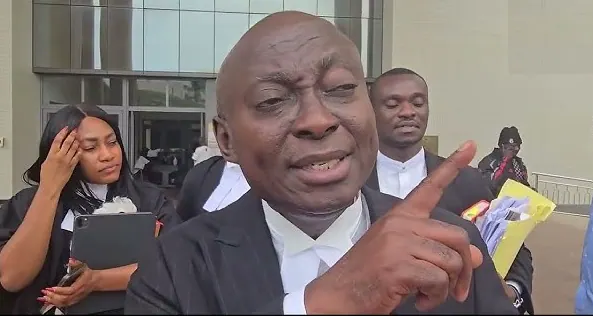
Lead counsel for former National Signals Bureau Director-General Kwabena Adu-Boahene, Samuel Atta Akyea, has filed a submission of no case to answer. The lawyer argues that the prosecution has failed to establish sufficient evidence to require his client's defence. This submission follows the closure of the prosecution's case in the trial involving Mr Adu-Boahene, his wife Angela Adjei-Boateng, and another accused person over alleged financial misconduct.
The defence was directed to file its submission by Friday, September 25, after the prosecution called four witnesses over the course of the trial. The Attorney-General has been given 14 days to respond after being served with the defence's submission. Mr Akyea's case is that significant evidential gaps, inconsistencies in the prosecution's evidence, and the absence of key witnesses undermine the State's case.
A major aspect of the defence's challenge concerns the prosecution's account of the GH¢49.1 million allegedly earmarked for the procurement of a cybersecurity system. The State alleges that the funds were transferred through three cheques from an account associated with National Security operations into an account belonging to BNC Communications Bureau Limited, a company linked to Mr Adu-Boahene and his wife.
The prosecution says the funds were subsequently dissipated and used for purposes unrelated to the intended procurement. However, during cross-examination of the prosecution's final witness, EOCO investigator Frank Marshall Cromwell, Mr Akyea challenged several aspects of the investigation and the conclusions drawn from the financial records. One of the key issues was the nature and control of the account from which the GH¢49.1 million was transferred.
Evidence before the court indicated that the account had a signing mandate involving the National Security Coordinator and Mr Adu-Boahene, among others. The three cheques at the centre of the prosecution's case were also said to bear the signatures of the National Security Coordinator and Mr Adu-Boahene. The defence relied on this evidence to challenge any suggestion that Mr Adu-Boahene had unilateral control over the funds.
The defence also raised questions about the prosecution's evidence concerning the alleged cybersecurity procurement. The State alleges that the GH¢49.1 million was intended to procure a cybersecurity system from Israeli company ISC Holdings but that the system was never delivered. During cross-examination, however, the EOCO investigator acknowledged that the agency did not independently engage ISC Holdings to establish whether the system had been purchased and delivered.
The accused persons have pleaded not guilty to the charges, which include stealing, conspiracy to steal, defrauding by false pretences, wilfully causing financial loss to the state, using public office for profit, and money laundering. Key points in the case include the alleged diversion of GH¢49.1 million, the absence of key witnesses, and inconsistencies in the prosecution's evidence.
Key points
- The prosecution's case relies heavily on financial records and witness testimony.
- The defence argues that significant evidential gaps and missing witnesses undermine the State's case.
- The accused persons face multiple charges, including stealing and money laundering.