The Adamawa State Government has announced plans to extend a leadership, governance and management training to local government areas and primary healthcare facilities across the state. This initiative, known as the Enhancing Leadership, Governance and Management Capacities (ELGMC) Project, aims to strengthen the state's health workforce and improve services. The project is being implemented by Development Governance International (DGI) Consult in collaboration with the United Nations Children's Fund (UNICEF).
The ELGMC Project is part of the four-year Strengthening Access to Reproductive and Adolescent Health (SARAH) Project, funded by the European Union and implemented by UNICEF and the United Nations Population Fund (UNFPA) in Adamawa, Kwara and Sokoto states. The wider project seeks to improve access to reproductive, maternal, newborn, child and adolescent health and nutrition services, as well as support responses to gender-based violence.
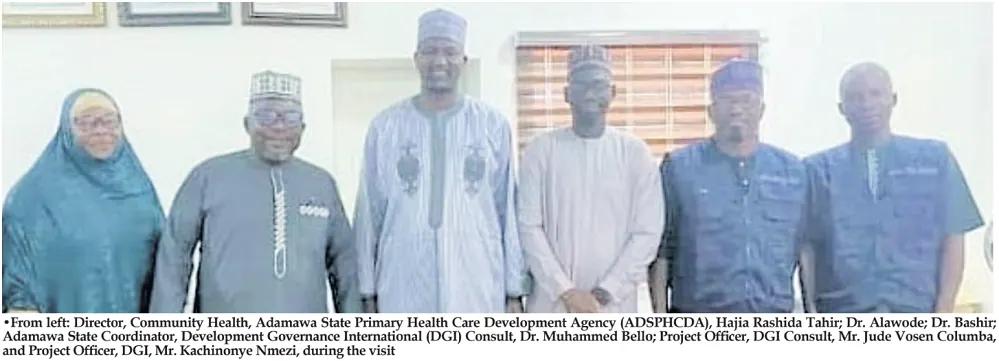
The Executive Chairman of the Adamawa State Primary Health Care Development Agency (ADSPHCDA), Dr Suleiman Saidu Bashir, announced the proposed expansion after receiving a DGI delegation. He emphasized the need for frontline health workers and managers to acquire stronger leadership skills to address service delivery challenges. Bashir indicated that the state would explore funding and implementation arrangements with its partners.
The proposed expansion is subject to planning and financing decisions, but the state hopes to include the training in the 2027 Annual Operational Plan. Dr Gafar Alawode, CEO of DGI, welcomed the state's interest, describing it as an encouraging response to the capacity-building initiative. He expressed DGI's readiness to continue discussions with state officials on practical arrangements for expansion.
The training has brought together health workers from supported facilities, Ward Development Committee chairmen and local government supervisors. Participants examined leadership and management gaps identified through a baseline assessment and practiced problem-solving using the "whole-part-rest" approach. The state is also discussing human resources for health reforms with DGI, including arrangements to replace departing health workers and proposals for rural posting allowances.
The initiative has received the support of the Deputy Governor, Prof. Kaletapwa George Farauta, who emphasized the importance of institutional leadership in achieving better health outcomes. Farauta thanked UNICEF and DGI for their partnership, saying their contributions are critical to building a stronger primary healthcare system. A baseline assessment across health institutions in Adamawa, Kwara and Sokoto identified weaknesses in leadership, governance and management.
The next test for Adamawa is turning the capacity-strengthening plan into practice, with adequate funding, consistent supervision and measurable improvements in care for the communities that depend on primary healthcare services. The state government's collaboration with UNICEF and DGI is expected to continue, with the goal of achieving impact at scale and improving the overall quality of healthcare services.
Key points
- The Adamawa State Government plans to expand leadership, governance and management training to local government areas and primary healthcare facilities.
- The training aims to strengthen the state's health workforce and improve services, particularly in reproductive, maternal, newborn, child and adolescent health and nutrition services.
- The expansion is subject to planning and financing decisions, with the state hoping to include the training in the 2027 Annual Operational Plan.