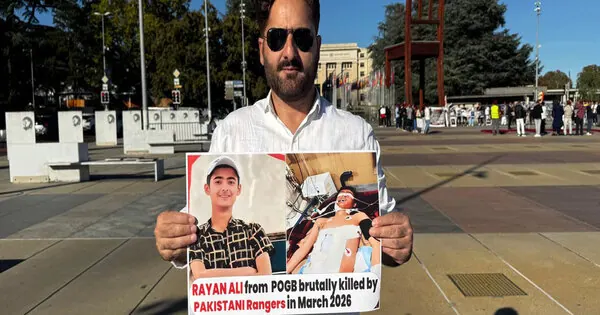
Human rights defender from Jammu and Kashmir, Javed Beigh, addressed the 63rd session of the United Nations Human Rights Council in Geneva, highlighting concerns over human rights violations and violence in Pakistan-occupied Gilgit-Baltistan (PoGB). Beigh emphasized that PoGB is an integral part of Jammu and Kashmir, which was snatched by Pakistan in 1947 and has been under illegal occupation ever since.
Beigh alleged that the Pakistani establishment and Pakistani Rangers are responsible for the violence and human rights violations in PoGB. He specifically mentioned the case of Advocate Ahsan Ali and his associates from the Awami Action Committee, who were detained for three months without bail. The Awami Action Committee is an amalgam of social, religious, and political organizations that Beigh described as "genuine leadership."
The detained members of the Awami Action Committee, including Advocate Ahsan Ali, were placed under Schedule 4 of Pakistan's anti-terrorism law. Beigh expressed concern over their treatment, stating that this law effectively puts individuals in a state of "hell while they are alive." He also raised the case of Rayan Ali, a teenage boy who was allegedly gunned down by Pakistani Rangers in PoGB.
Beigh condemned the killing of Rayan Ali and urged the international community, particularly the UNHRC, to hold Pakistan responsible for such "barbaric and cowardly acts." He requested that the UNHRC take cognizance of the situation in PoGB and hold the Pakistani government accountable for the atrocities committed against the civilian population.
Beigh reiterated that PoGB and Pakistan-occupied Jammu and Kashmir (PoJK) are parts of Jammu and Kashmir that will eventually be reunited with the greater region. He stated that the people of Jammu and Kashmir have consistently spoken out for the people of PoGB, understanding their pain and struggles since 1947.
Beigh also highlighted the differences between PoGB and the Ladakh area of Jammu and Kashmir, noting that PoGB is a part of the greater Ladakh region. He mentioned infrastructure projects such as the Z-Morh Tunnel and Zojila Tunnel, which aim to connect Jammu and Kashmir and Ladakh's remote areas. However, he claimed that the China-Pakistan Economic Corridor (CPEC) has not benefited PoGB.
Beigh's address at the UNHRC aimed to bring international attention to the situation in PoGB and to urge the global community to take action against the human rights violations committed by the Pakistani establishment. His statements emphasized the need for accountability and the importance of recognizing the rights and struggles of the people in PoGB.
Key points
- - Human rights defender Javed Beigh addressed the UNHRC, raising concerns over human rights violations in PoGB. - Beigh alleged that the Pakistani establishment and Rangers are responsible for violence and human rights abuses in PoGB. - He urged the international community to hold Pakistan accountable for its actions in PoGB.