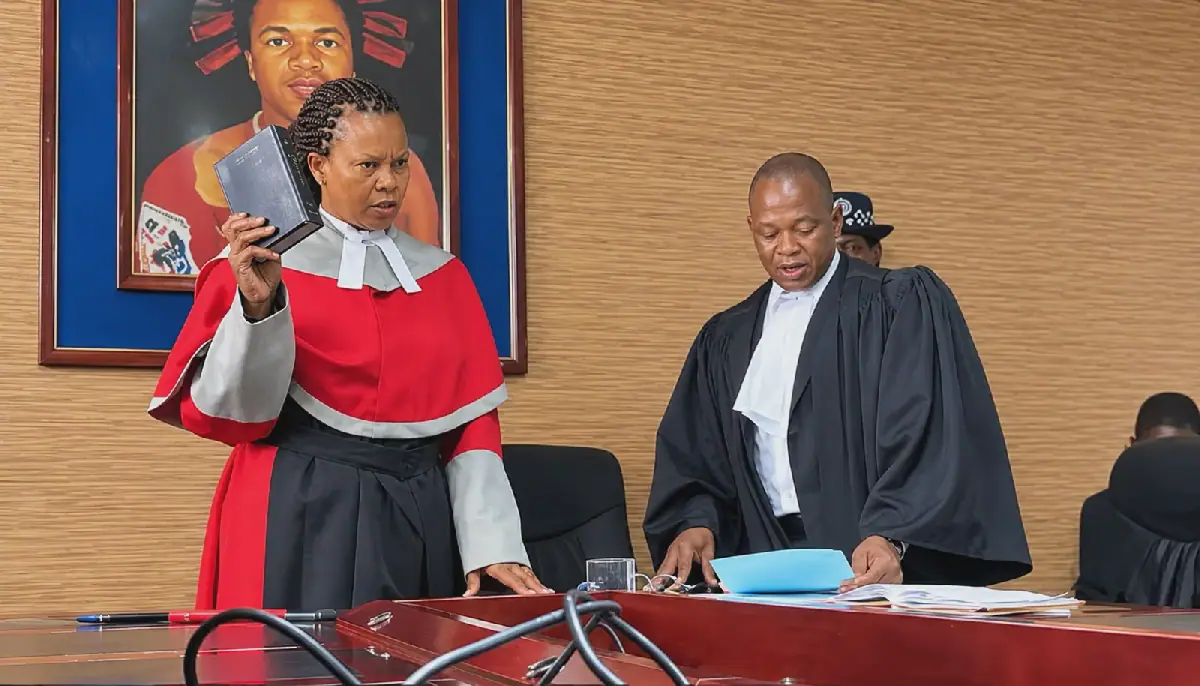
Acting Chief Justice Mumcy Dlamini has taken over the Eswatini Judiciary, which is facing 23 institutional, administrative and operational issues affecting the administration of justice. Her appointment makes her the first liSwati woman to occupy the Office of Chief Justice, albeit in an acting capacity. The issues range from a substantial backlog of civil and criminal cases to shortages of judicial officers, court support staff and courtrooms.
One of the major issues Dlamini inherits is the backlog of civil and criminal cases, with over 29 000 cases reported in July 2025. A proposed five-year strategy to address the backlog includes establishing a Criminal Case Clearing Committee to identify stagnant matters and improve co-operation among institutions involved in justice administration. Some cases have remained unresolved for a decade or longer, with consequences for people awaiting trial in Correctional facilities.
A UNDP report published on July 8, 2025, found that nine out of Eswatini's 11 Correctional facilities had accused persons detained for more than 12 months without trial. The facilities accommodating pre-trial detainees had exceeded their combined capacity by nearly 50 per cent. Factors contributing to delays include pending committals to the High Court, expired contracts for acting judicial officers and delayed judgments and sentences.
The delay in committing cases from magistrates courts to the High Court is another concern, particularly for serious offences that must be heard by the High Court. The UNDP assessment identified cases awaiting judgments and sentences in both magistrates courts and the High Court, with delays after hearings prolonging the period accused persons remain in custody.
The shortage of judges and magistrates is another challenge, with the Ministry of Justice and Constitutional Affairs' 2024/2025 Annual Performance Report identifying vacancies involving judicial officers. The late chief justice had highlighted the shortage during a visit to the Manzini Magistrates Court in July 2025. The Judiciary also requires sufficient administrative and support personnel to keep its operations running.
The availability of suitable court facilities is a concern, with the ministry's annual performance report stating an acute shortage of courtrooms, resulting in judges and magistrates sharing facilities. The Judicial Service Commission embarked on a nationwide inspection of court infrastructure in September 2025, examining courtrooms, offices and digital recording systems.
The Judiciary's financial resources are also a concern, with the ministry's 2024/2025 Annual Performance Report highlighting the need for adequate funding. Acting CJ Dlamini must address these issues to improve the administration of justice in Eswatini. Her appointment was announced by the Minister for Justice and Constitutional Affairs, Prince Simelane, who was accompanied by members of the Judicial Service Commission.
Key points
- Eswatini's Acting CJ Mumcy Dlamini faces a backlog of over 29 000 cases.
- Nine out of 11 Correctional facilities had accused persons detained for more than 12 months without trial.
- The Judiciary requires sufficient administrative and support personnel to keep its operations running.
Reporting sources
- 23 issues await Acting CJ Mumcy · Times of Swaziland