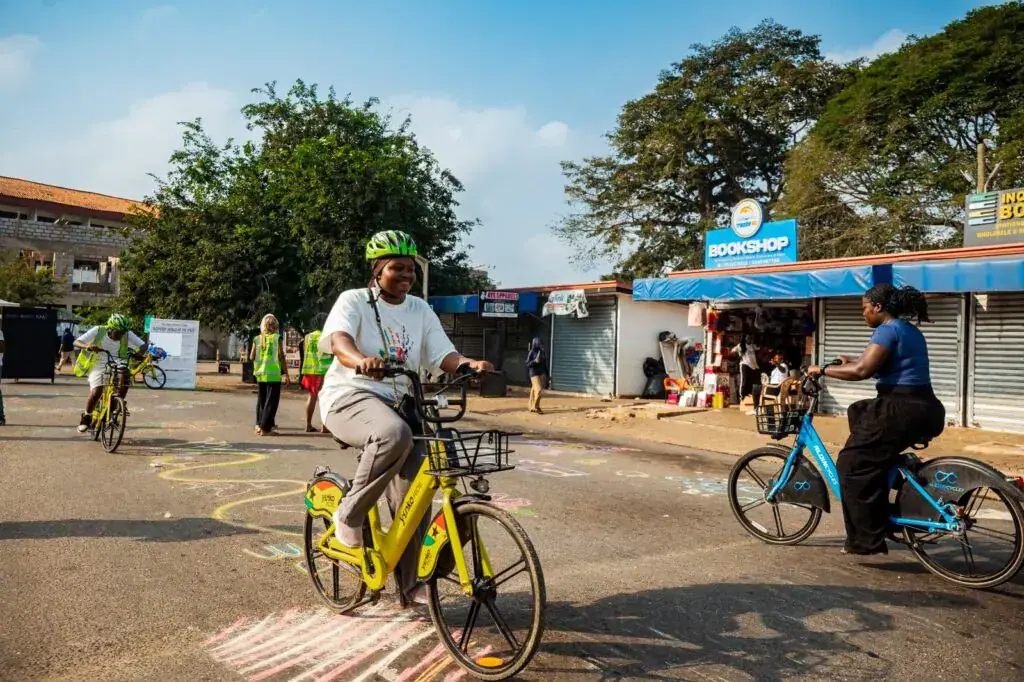
On a Saturday in November, a stretch of road near the University of Ghana's Banking Square was closed to cars and taken over by cyclists, walkers, and children. This was the second activation of the Open Street Fair, a campaign by young Accra residents to reimagine the city's streets. The initiative is run by Transform Transport Accra, UrbanBetter Accra Cityzens, and Global Shapers Accra, with support from the United Nations Environment Programme, the WALK21 Foundation, and Germany's Federal Ministry for Economic Cooperation and Development.
The first road closure took place on Manhia Road at Abelemkpe on November 14, and the University of Ghana activation drew a large crowd. People tested e-bicycles, rode an electric bus, cycled, and walked, while children and adults played games on the open tarmac. A third activation is planned for the Ga Central Municipal Assembly's Israel Park in Sowutuom. The campaign aims to show Accra residents what cleaner and safer alternatives to car travel could look like.
According to the Organisation for Economic Co-operation and Development, cars occupy 75 percent of Accra's road space, despite most residents traveling on foot or by trotro. Road transport accounts for about 39 percent of fine particulate matter pollution in the city, linked to old and poorly regulated petrol and diesel vehicles. This pollution has significant health consequences, with air pollution estimated to cause between 28,000 and 32,000 deaths across Ghana each year.
The Environmental Protection Agency estimated 2,800 air-pollution-linked deaths in Greater Accra in 2015, a figure projected to climb to about 4,600 by 2030 without intervention. Campaign Coordinator Ephraim Nii Ajomoku Danso said the vision behind the project goes beyond transport, aiming to create spaces for people to live, connect, work, breathe, and move.
Godwin Yao Doe, curator of Global Shapers Accra, described the closures as a form of tactical mobility meant to test alternatives on the ground. The closures challenge the way streets are designed and used, with young volunteers also collecting data on air quality and road conditions across Accra.
The Open Street Fair's next stop, after Sowutuom, is expected to take the campaign to Osu. The initiative has garnered support from various organizations, including the United Nations Environment Programme and the WALK21 Foundation. The campaign's goal is to promote people-first streets in Accra and create a healthier environment for residents.
The Open Street Fair is part of a growing movement to reimagine urban spaces and prioritize people over cars. With the support of various organizations and the participation of young volunteers, the campaign aims to create a more sustainable and equitable transportation system in Accra.
Key points
- The Open Street Fair campaign aims to showcase cleaner and safer alternatives to car travel in Accra.
- The campaign is supported by various organizations, including the United Nations Environment Programme and the WALK21 Foundation.
- Air pollution from road transport is a significant health concern in Accra, with an estimated 2,800 air-pollution-linked deaths in Greater Accra in 2015.