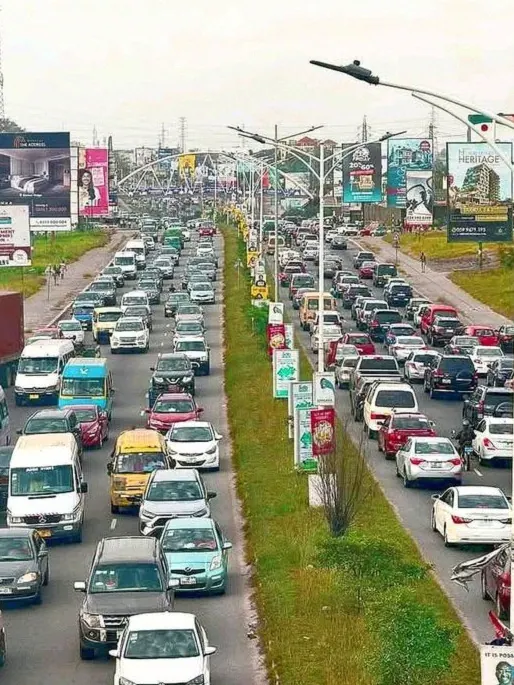
Accra, the capital of Ghana, has been ranked as the third most polluted major city in Africa and 56th globally, according to live data from IQAir, a global air quality monitor. On October 7, 2026, Accra recorded a US Air Quality Index (AQI) reading of 64, which falls within the "Moderate" category. This ranking is based on the city's air quality being generally acceptable for most people, though those especially sensitive to pollution could experience some effects.
The ranking is based on IQAir's live data, which places Accra behind only Kinshasa in the Democratic Republic of the Congo and Cairo in Egypt among major African cities. Kinshasa topped the African list with an AQI of 86, followed by Cairo at 81. Other African capitals, including Addis Ababa in Ethiopia, Nairobi in Kenya, and Algiers in Algeria, have better air quality, with AQI readings of 59, 58, and 53, respectively.
The main pollutant driving Accra's reading is fine particulate matter known as PM2.5, measured at 15.8 µg/m³ according to the air quality map. PM2.5 refers to tiny airborne particles small enough to penetrate deep into the lungs and bloodstream, typically linked to vehicle exhaust, dust, smoke from burning, and industrial emissions.
Accra's air quality is shaped by various factors, including vehicle emissions, road dust, construction activity, industrial operations, and the open burning of municipal waste, plastics, and electronic waste. Household cooking with charcoal and firewood, particularly in densely populated neighborhoods, also contributes to the city's poor air quality.
The ranking adds hard numbers to a problem many residents already notice: hazy skies, dusty streets, and the smell of burning refuse on certain days. Residents, especially those in traffic-heavy corridors or living near construction sites and waste-burning areas, are likely to be affected by the poor air quality.
In the absence of official action, individuals can take steps to minimize their exposure to poor air quality, such as monitoring real-time AQI readings, limiting prolonged outdoor activity when pollution spikes, keeping windows shut during poor air quality periods, using indoor air filtration where possible, and seeking medical advice for anyone experiencing respiratory symptoms.
No government response or policy announcement has been reported in connection with this specific ranking, and no timeline has been given for when Accra's air quality might improve or for any coordinated clean-air initiative. Sources did not indicate whether city or national authorities plan to respond to the latest figures.
Key points
- Accra's AQI reading of 64 places it 56th in IQAir's worldwide ranking of major cities.
- The main pollutant driving Accra's reading is fine particulate matter known as PM2.5.
- Residents can take steps to minimize exposure to poor air quality, such as monitoring real-time AQI readings and limiting outdoor activity when pollution spikes.