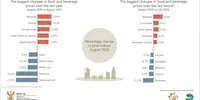
South Africa's agricultural sector has experienced an excellent season in 2025/26, resulting in a significant decrease in consumer food price inflation. According to data released by Statistics South Africa on 23 September 2026, consumer food price inflation was 0.7% in August 2026, up from 0.6% the previous month. These levels are the lowest since 2010. Wandile Sihlobo, Presidential Envoy on Agriculture and Land, attributes this to the country's abundant grains, fruit, and vegetables.
The key products keeping consumer food price inflation low are mainly grain-related, fruits, and vegetables, which are currently in deflation. Meat price inflation has also moderated, suggesting steady slaughtering activity. However, fears of foot-and-mouth disease have added upside pressure on red meat prices over the past few months. Only fish and seafood, milk, dairy products, and eggs nudged up in August, but these products have lower weighting and do not materially increase the headline food price inflation figure.
South Africa's summer grains and oilseeds production is forecast at a record 21.6 million tonnes, up 5% from the 2024-25 season. This ample harvest adds to already large stocks from the past season, keeping grain prices under pressure. Similarly, fruit and vegetable prices are trending lower, despite recent floods in parts of the Eastern and Western Cape. Vegetable production conditions remain broadly favourable.
The livestock industry, specifically cattle, continues to face foot-and-mouth disease challenges. Despite progress with vaccination, this has been the sector's major challenge since the start of the year and has led to subpar performance in this subsector. The wheat industry has also had a challenging start to the 2026-27 season due to higher input costs and drier weather conditions.
South Africa's agricultural exports amounted to $7.8-billion in the first half of 2026, up 11% from the first half of 2025. However, inefficiencies at the Port of Cape Town forced farmers and some agricultural exporters to move produce to the Eastern Cape, affecting profitability. The country's 2026-27 winter wheat production estimate is 1.8 million tonnes, down 8% from the previous season and the lowest expected harvest in eight years.
Despite challenges, South Africans continue to benefit from the ample agricultural harvests of the 2025-26 season. However, concerns about the US-Iran war and its potential impact on fuel costs, as well as the forecast El Niño drought, may affect food price inflation in the near term. Fuel accounts for a substantial share of food distribution costs, with over 80% of staple food products transported by road.
The forecast El Niño drought may only affect the direction of 2027 food price inflation, as it affects next season's crop, which will be planted from mid-October and come to market in mid-2027. For now, the country's agricultural sector remains optimistic about the current harvest and its impact on food prices.
Key points
- South Africa's abundant grain harvest has kept food prices low, with consumer food price inflation at 0.7% in August 2026.
- The country's agricultural exports have increased by 11% to $7.8-billion in the first half of 2026.
- Concerns about the US-Iran war and the forecast El Niño drought may affect food price inflation in the near term.