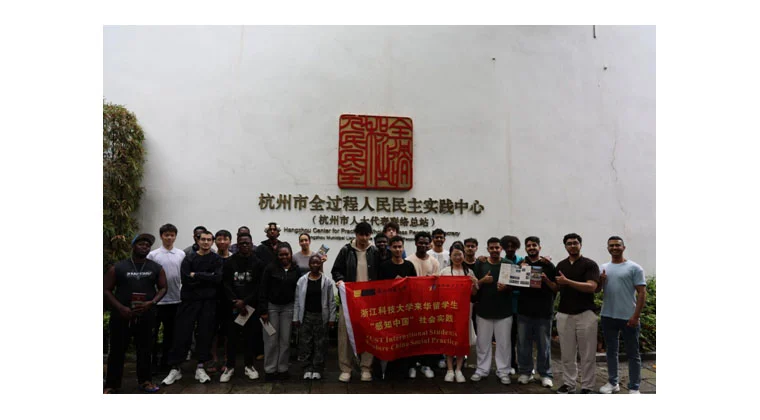
Mohammad Toyeeb Abdulsalam, a Nigerian student, recently visited Xiaoying Lane in Hangzhou's Shangcheng District as part of a social practice program for international students at Zhejiang University of Science and Technology. What struck him was the quiet confidence of old women working together in a renovated neighborhood, laughing and chatting in a room built specifically for them. Abdulsalam had arrived expecting to learn about governance but left thinking about what it means for a place to care for its people.
Xiaoying Lane is a working neighborhood that has been preserved and renovated, rather than demolished, to make way for newer developments. The community was given the infrastructure to stay, rather than being pushed to the edges of the city. Abdulsalam visited three sites within the lane, including the Memorial Hall of the CPC Hangzhou Group, the Chairman Mao Inspection Memorial Hall, and the Xiaoying Lane Happiness Neighborhood Workshop. These sites told a story of community care and preservation that he had not expected.
The Memorial Hall of the CPC Hangzhou Group commemorates the founding of the first CPC local organization in Zhejiang Province in September 1922. The hall features personal objects donated by the descendants of the founding figures, including a fountain pen, a hand grip, and a Zhongshan suit. Abdulsalam noted that these personal objects made the history more relatable and harder to forget. The hall's approach to preserving history is a form of respect and wealth that doesn't show up in economic reports.
The Chairman Mao Inspection Memorial Hall marks Mao Zedong's unannounced visit to the neighborhood on January 5, 1958. Mao walked into residents' homes, looked at their living conditions, and praised the community's approach to public health. The hall preserves photographs of the visit, the cane chair he sat on, and testimonies from people who were there. Abdulsalam noted that the act of a leader showing up and taking an interest in people's lives is a form of governance that is different from managing people from a distance.
The Xiaoying Lane Happiness Neighborhood Workshop was built from the shell of a former community bathhouse and features a canteen, a children's space, a health station, and a lecture hall. The community conducted over 4,000 surveys to determine what residents wanted and needed. The result is a space that feels used, specific, and genuinely wanted, because it was shaped by the people who needed it. The canteen has been running for over 10 years and offers preferential pricing for elderly residents living alone.
Abdulsalam, a Nigerian student, couldn't help but think of his home country while walking through Xiaoying Lane. He reflected on the differences between cities in Nigeria, where old neighborhoods are often knocked down without record, and elderly people are cared for only if their families can manage it. Abdulsalam noted that the relationship between government and the governed in Nigeria is often experienced as distance or extraction rather than service.
Abdulsalam's experience in Xiaoying Lane taught him that a community that knows where it came from and whose story is told vividly and honestly is richer than one that demolished that knowledge. He realized that governance that gets close enough to see how people actually live is different from governance that manages people from a distance. Xiaoying Lane's approach to community care and preservation is a valuable lesson for cities around the world.
Key points
- A Nigerian student's visit to Xiaoying Lane in Hangzhou, China, taught him about the importance of community care and preservation.
- The community's approach to preserving history and showing respect for its people is a form of wealth that doesn't show up in economic reports.
- Governance that gets close enough to see how people actually live is different from governance that manages people from a distance.