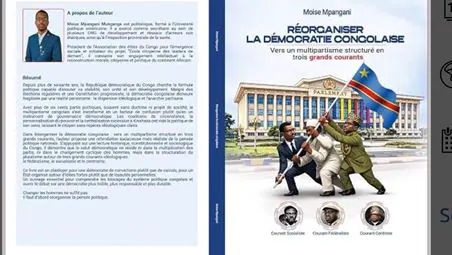
A book titled "Réorganiser la démocratie congolaise" (Reorganizing Congolese Democracy) by Moise Munganga has sparked a new debate on the structure of the multi-party system in the Democratic Republic of the Congo (DRC). The book, published by American Writers Club, proposes a reflection on the organization of the multi-party system and the readability of different political visions in the DRC. According to the author, the current system is often marked by personalities, circumstantial alliances, political poaching, and immediate electoral interests.
Moise Munganga argues that the multiplication of political parties in the DRC does not necessarily translate to a diversity of clearly identifiable political visions. He suggests that the system should be made more coherent, readable, and effective, without abolishing democracy or the multi-party system. The author proposes a model that would allow citizens to better understand the vision defended by each political current before making their electoral choice.
The book identifies three main political currents: socialism, federalism, and centrism. Socialism is presented as a way to address issues of social justice, redistribution, and worker protection. Federalism is associated with decentralization, provincial autonomy, and local accountability. Centrism is described as a search for balance, stability, compromise, and pragmatism in state management. According to Munganga, the DRC needs these different forces, but it cannot follow three contradictory paths at the same time.
Munganga suggests that one current should receive the mandate to govern, while the others would play a role of control and proposal. He emphasizes that the citizen must be able to look at an election and understand the vision defended by each current. The book aims to contribute to the debate on the future of the DRC and is addressed to various categories of readers, including young people, students, researchers, and members of civil society.
The author explains that his book is not a claim to possess absolute truth about the DRC's political future but rather a contribution to the debate. He also wanted to recall the importance of the country's political and intellectual memory, as well as the need to learn from the past. The book's cover features historical figures, highlighting the significance of remembering the DRC's past.
Munganga hopes that democracy will allow the people not only to choose individuals but also to understand the different political visions proposed to them. The book has 73 pages and is intended for a wide audience interested in the DRC's future. The author believes that his proposal can help bring more coherence and effectiveness to the multi-party system.
The book's release has sparked interest in the DRC's literary scene, with other cultural events announced, including the unveiling of a collection in tribute to Franco Luambo and the presentation of a comic book titled "Shango et Zaïire." A cultural media center for disadvantaged young people is also planned in Kinshasa. The DRC's cultural scene is vibrant, with many initiatives aimed at promoting the country's memory, values, and artistic expression.
Key points
- The book proposes three main political currents: socialism, federalism, and centrism, to structure the multi-party system in the DRC.
- The author, Moise Munganga, aims to make the system more coherent, readable, and effective without abolishing democracy or the multi-party system.
- The book is addressed to various categories of readers, including young people, students, researchers, and members of civil society interested in the DRC's future.