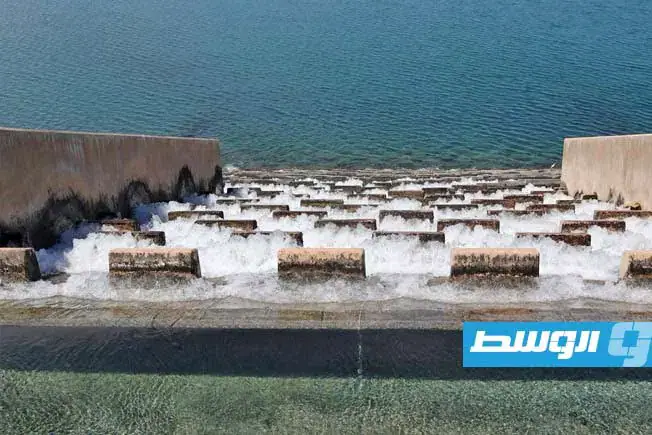
A recent study published in the international scientific journal Sciencepost has found that 70% of Libya's fresh water consumption comes from a fossil water aquifer that no longer replenishes with rainfall. The study highlights that 6.5 million cubic meters of fresh water flow daily through pipes buried under the Libyan desert, equivalent to 2600 Olympic-sized swimming pools. This water is distributed to cities like Tripoli, Benghazi, and Sirte within 24 hours.
The man-made river, also known as the Great Man-Made River Project, consists of 2820 kilometers of underground pipes and water channels. The project was initiated in the late 1960s and took over 15 years to start construction, with the foundation stone laid on August 28, 1984, by Colonel Muammar Gaddafi. The project is considered one of the most ambitious undertakings in Africa, aiming to provide fresh water to the Libyan population.
The water source for the project comes from the Nubian Sandstone Aquifer System, a fossil water aquifer that spans across Libya, Egypt, Chad, and Sudan. The aquifer, formed during the last ice age, is not replenished by rainfall due to the current arid climate. According to estimates, the aquifer holds approximately 373 trillion cubic meters of fresh water, covering an area of nearly 2 million square kilometers.
The project relies on over 1300 wells, mostly drilled to depths exceeding 500 meters into the aquifer. A series of pumping stations then push the water northward, sometimes up to 1600 kilometers, between water collection areas and the Mediterranean coast. The infrastructure includes massive concrete pipes buried in trenches extending hundreds of kilometers.
However, the project faces challenges, including a declining water table. A 2022 study on the Tazirbu well field in southeastern Libya found an 28-meter decline in the water table between 2004 and 2019. This has resulted in reduced production, with the well field now operating at only a third of its planned capacity. Additionally, researchers have discovered land subsidence and naturally high levels of iron and manganese in the water.
The sustainability of the project is a concern, with estimates suggesting the water will last between 60 to 100 years at current consumption rates, while others predict it could last up to 1000 years. The disparity in estimates may be due to assumptions about the aquifer's size and future extraction rates. The project's vulnerability is further exacerbated by its infrastructure, which requires regular maintenance.
The project's impact extends beyond Libya's borders, as it taps into a shared aquifer with neighboring countries. Experts stress the need for careful management to ensure the long-term sustainability of this vital resource. The Sciencepost study emphasizes the importance of monitoring and maintaining the infrastructure to prevent disruptions in water supplies to coastal cities.
Key points
- The Great Man-Made River Project relies on a non-renewable aquifer for 70% of Libya's fresh water consumption.
- The project's infrastructure faces challenges, including declining water tables and land subsidence.
- Estimates of the aquifer's lifespan vary widely, from 60 to 100 years to up to 1000 years.