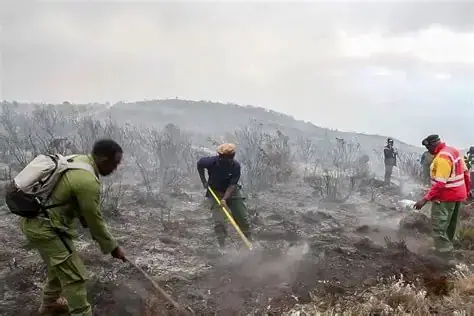
The Antalya Action Plan on Integrated Fire Management was launched by the COP31 Presidency, led by Türkiye, with co-leadership from Brazil and the Republic of Korea. The plan is supported by 24 participating countries and aims to build a community of countries working to strengthen international cooperation, share expertise, and expand access to technology, training, and resources needed to prevent, prepare for, respond to, and recover from wildfires. This initiative comes as extreme wildfires have become one of the greatest threats to the world's forests.
Extreme wildfires have become a significant threat to global forests, with 2024 seeing the leading driver of tropical primary forest loss for the first time on record. In 2025, fires accounted for 42 per cent of tree cover loss globally. If no action is taken, extreme wildfire events are projected to increase by up to 50 per cent by the end of the century, threatening progress towards the global goal of halting and reversing forest loss by 2030. The consequences of intensifying global wildfires also pose an increasing risk to economic resilience and human health.
The Antalya Action Plan builds on international commitments made in 2025, including the Istanbul Report on Integrated Fire Management and the Belém Call to Action on Integrated Fire Management and Wildfire Resilience at COP30. The Plan provides a practical framework for countries to share proven measures, collaborate across borders, and understand progress without creating new legal, financial, or administrative burdens. Supported by the Global Fire Management Hub Secretariat, participating countries will showcase progress, new approaches, and initiatives.
Countries are stepping up action to manage extreme wildfires, with new national policies, satellite monitoring, and community-led fire management among the measures highlighted at COP31. Bolivia has shifted its wildfire strategy to prioritize prevention over response, adopting an Integrated Fire Management Strategy to 2035 that directs 90 per cent of dedicated resources toward proactive risk mitigation. The country has established a national Ministerial Resolution and inter-institutional coordination group linking fire prevention directly to environmental governance and climate resilience.
Brazil has become one of the few countries worldwide with a national policy on integrated fire management, with Federal Law No. 14,944 of 2024. The law aims to build fire-resilient communities and landscapes across Brazil's six biomes by changing how people decide where, when, and why to use fire. States must plan for their highest-risk areas, and Brazil is calling on municipalities, farmers, and ranchers to develop multi-year plans for the lands they manage. These plans draw on traditional knowledge and fire science to identify where carefully timed burns can sustain livelihoods or conserve native species.
Canada has committed over CAD$120 million towards global wildfire management and resilience, including over CAD$13 million to the FAO Global Fire Management Hub. Canada also established the International Indigenous-led Fire Adaptation Network and committed CAD$68.9 million to expand the WildFireSat wildfire monitoring satellite mission. Colombia is advancing a prevention-focused approach to integrated fire management, with a bill establishing national guidelines for integrated fire management passing its first debate in Congress in October 2026.
Ecuador has advanced its national wildfire resilience by officially enacting the National Strategy for Integrated Fire Management and its National Action Plan, establishing a binding 10-year policy framework that shifts the country from reactive fire suppression to proactive community-based prevention and agroforestry alternatives to traditional burning. Honduras is also leading an integrated approach to wildfire prevention and response, coordinated by the National Forest Conservation Institute.
Key points
- The Antalya Action Plan on Integrated Fire Management was launched at COP31.
- 23 countries have backed the global action plan to tackle escalating wildfire threats.
- The plan aims to build a community of countries working to strengthen international cooperation on wildfire prevention and resilience.
Reporting sources
- COP31: Global action plan to tackle escalating wildfire threats now backed by 23 countries · The Tanzania Times – News from Tanzania, Africa, World, Breaking News, Weather, Environment and Climate Change