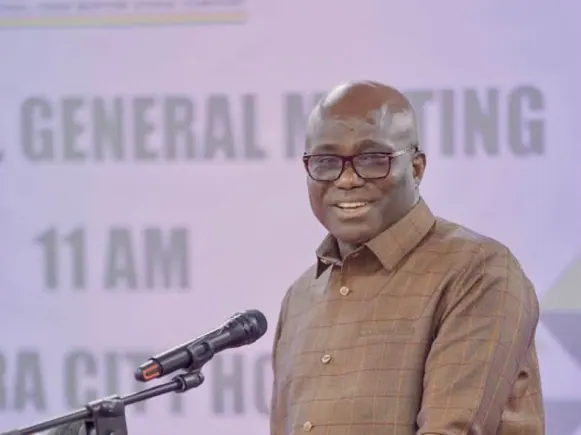
Ghana's Minister of Food and Agriculture, Eric Opoku, has announced that adequate allocations will be made in the 2027 budget for the construction of silos for grain storage. This move aims to support the growing level of cereal production in the country. Last year, Ghana produced 4.6 million tonnes of maize, surpassing the estimated national demand of 3.6 million tonnes and creating a surplus of about one million tonnes.
The Minister made this disclosure at the first Annual General Meeting of the Ghana Food Buffer Stock Company (NAFCO) in Accra. The meeting, held on the theme "Strengthening Food Security through Strategic Partnership," provided an opportunity for NAFCO to present its annual reports and financial statements for the financial years from December 31, 2010, through December 31 last year. The Minister urged NAFCO to play a critical role in putting up many silos to store the growing level of cereal production.
Strengthening NAFCO's capacity to mop up excess production will help create a reliable market for farmers while ensuring that increased domestic production does not translate into losses for producers. Currently, NAFCO has 20,443 tonnes of grains in storage, a step towards rebuilding the country's strategic food reserves. The Minister said his ministry had worked with the board and management to strengthen NAFCO's operations and rebuild its reserves after years of financial and operational constraints.
The government has directed NAFCO to release 50,000 bags of grains to settle Ghana's outstanding obligation to the Economic Community of West African States (ECOWAS). In 2018, Ghana borrowed grains from ECOWAS to support the School Feeding Programme. The Minister noted that with prudent management, NAFCO has procured enough grains to pay back what was borrowed.
The Minister further directed NAFCO to ensure that suppliers contracted to support public feeding programmes purchase food directly from Ghanaian farmers rather than relying on imported produce. He stated that purchasing imported food for programmes such as Free SHS undermines local production, creating jobs outside the country while reducing demand for locally produced food.
NAFCO's Chief Executive Officer (CEO), George Abradu-Otoo, reported that the company recorded profits in some previous years, including 2018, 2019, 2020, 2022, and 2023, but the latest performance surpassed all previous results. The 2025 net profit before tax of GH¢91.7 million erased a GH¢19.4 million loss posted the previous year, representing the highest profit made by the company.
The CEO attributed the improvement to stronger cost discipline and revenue growth, with the company's gross profit margin increasing significantly from 1.61 per cent in 2024 to 13.96 per cent in 2025. NAFCO's return on operating assets also rose from negative 63.80 per cent to positive 26.29 per cent, reflecting improved deployment and management of the company's assets. The company paid GH¢20.3 million in taxes to the state in 2025, its highest annual tax contribution in its 16-year history.
Key points
- The 2027 budget will allocate funds for the construction of grain silos to support farmers and ensure food security.
- NAFCO has recorded a significant increase in profit, with a 2025 net profit before tax of GH¢91.7 million.
- The government has directed NAFCO to prioritize purchasing food from Ghanaian farmers for public feeding programmes.