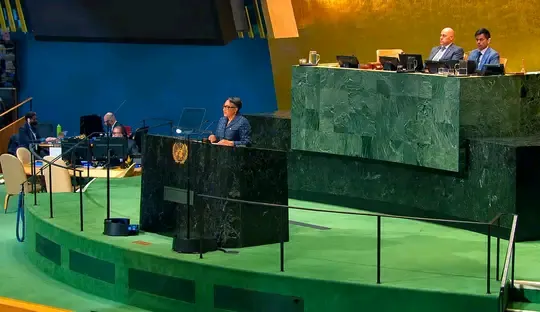
On September 24, 2026, Democratic Republic of the Congo (DRC) Prime Minister Judith Suminwa addressed the United Nations, providing an update on the country's response to the 17th Ebola outbreak. The outbreak, caused by the Bundibugyo strain of the Ebola virus, has been a significant challenge for the DRC. Suminwa emphasized the importance of international cooperation and local expertise in containing the outbreak.
Suminwa highlighted the DRC's experience in responding to Ebola outbreaks, having successfully contained 16 previous outbreaks. She credited the country's scientific and operational expertise, as well as the support of international partners, for the progress made in responding to the current outbreak. The Prime Minister also acknowledged the crucial role played by healthcare workers, researchers, and local communities in the response efforts.
According to Suminwa, the response efforts have yielded tangible results, with a decline in new cases and improved patient outcomes. She attributed this success to the national mobilization and support from international partners. The DRC government has also been conducting clinical trials to evaluate vaccines and treatments adapted to the Bundibugyo strain of the Ebola virus.
The Prime Minister paid tribute to the healthcare workers, both Congolese and international, who have been working tirelessly to contain the outbreak. She also emphasized the need for climate justice, highlighting the DRC's critical role in regulating the global climate as home to a significant portion of the Congo Basin.
Suminwa's address to the UN also touched on the broader challenges facing the DRC, including the exploitation of its natural resources. She called for international cooperation to address these issues and ensure sustainable development. The Prime Minister's statement was well-received by the international community, which has been providing support to the DRC in its response to the Ebola outbreak.
The 17th Ebola outbreak in the DRC has presented significant challenges, but the government's response efforts have been bolstered by international support. The World Health Organization (WHO) and other global health partners have been working closely with the DRC government to provide technical assistance, supplies, and personnel to support the response.
As the DRC continues to respond to the Ebola outbreak, the government remains committed to addressing the root causes of the crisis. Suminwa's address to the UN highlighted the need for sustained international support and cooperation to ensure the country's long-term stability and prosperity. The DRC's experience in responding to Ebola outbreaks serves as a testament to the country's resilience and determination.
Key points
- The DRC has successfully contained 16 previous Ebola outbreaks, and the current response efforts have yielded tangible results.
- International cooperation and local expertise have been crucial in responding to the 17th Ebola outbreak.
- The DRC government continues to prioritize the response to the Ebola outbreak, with a focus on addressing the root causes of the crisis.