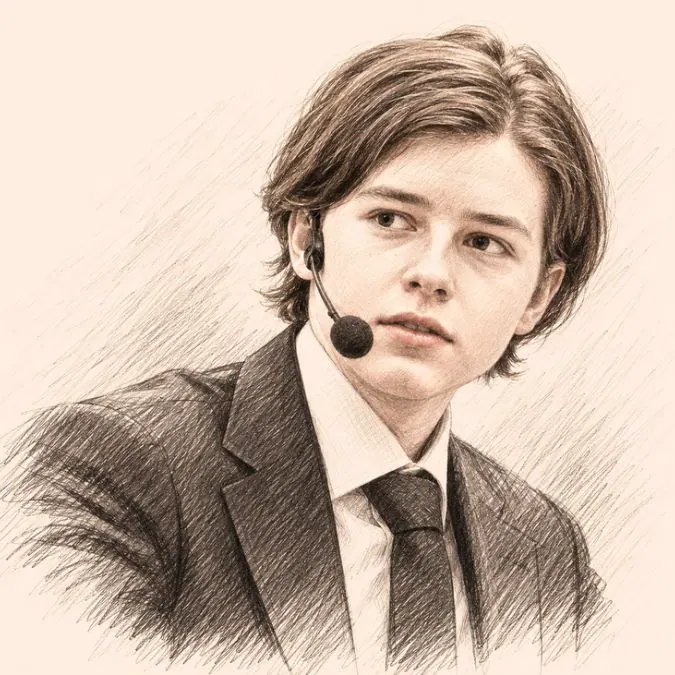
At 15 years old, Laurent Simons, a Belgian-Dutch prodigy, defended his PhD thesis in quantum physics at the University of Antwerp. His thesis, titled "Bose polarons in superfluids and supersolids," was supervised by Jacques Tempere and Michiel Wouters. This achievement marked a significant milestone in his academic journey, which began with completing secondary education at just eight years old. Simons' work in quantum physics has garnered international attention, with some dubbing him the "mini Einstein." However, his research goes beyond popular representations of quantum physics.
Simons' research focuses on the theoretical behavior of particles in extremely cold quantum environments and their interactions with excitations in these environments. His work involves mathematical and theoretical specializations in fundamental research. In February 2025, his article, co-authored with Michiel Wouters and Jacques Tempere, was published in the Physical Review B journal. The study examined the behavior of an impurity in a one-dimensional dipolar supersolid using a theoretical method based on path integrals. This publication demonstrates his scientific contributions to the field of quantum physics.
At 16, Simons is shifting his focus towards medical sciences and artificial intelligence. In an interview on The Lisa Wexler Show in May 2026, he discussed his ambitions for medical AI and extending human life. This new direction represents a significant change in scale, moving from studying fundamental properties of matter to questions related to human body function. AI is one of the potential tools for analyzing complex biological and medical data. However, transitioning from theoretical research to therapeutic applications is a lengthy process, subject to scientific and clinical validations.
Simons' goal of radically prolonging human life has garnered significant attention. However, it's essential to distinguish between his accomplishments in quantum physics and his ambitions for longevity, which remain a research program and personal vision. There is no clinical evidence to support claims that he has developed a method to stop aging or render humans immortal. This distinction is crucial in evaluating his journey without mistaking ambition for discovery.
Simons' academic precocity raises questions about transforming exceptional scientific abilities into lasting contributions to knowledge. The answer will depend not only on his future research pace but also on the quality of his work, peer evaluation, and potential medical applications. For Simons, the genuine scientific challenge may begin where the fascination with his age ends. His future research endeavors will likely be closely monitored by the scientific community.
Simons' progression has been remarkable, with a university degree in physics at 11 and completing secondary education at eight. His early achievements have drawn international media attention, but it's essential to focus on the substance of his research rather than his age. His work in quantum physics and potential applications in medicine will be crucial in determining his long-term impact on the scientific community.
As Simons continues his research, he will likely face scrutiny and high expectations. His ability to adapt to new fields and contribute meaningfully will be essential in establishing a lasting legacy. With his unique blend of quantum physics expertise and interest in medical AI, Simons may make significant contributions to our understanding of human life and its limitations.
Key points
- Laurent Simons, 16, has completed a PhD in quantum physics and is now exploring medical applications of artificial intelligence.
- His research focuses on understanding human aging and potentially extending human life.
- Simons' work has garnered international attention, but it's essential to evaluate his contributions based on scientific merit rather than his age.