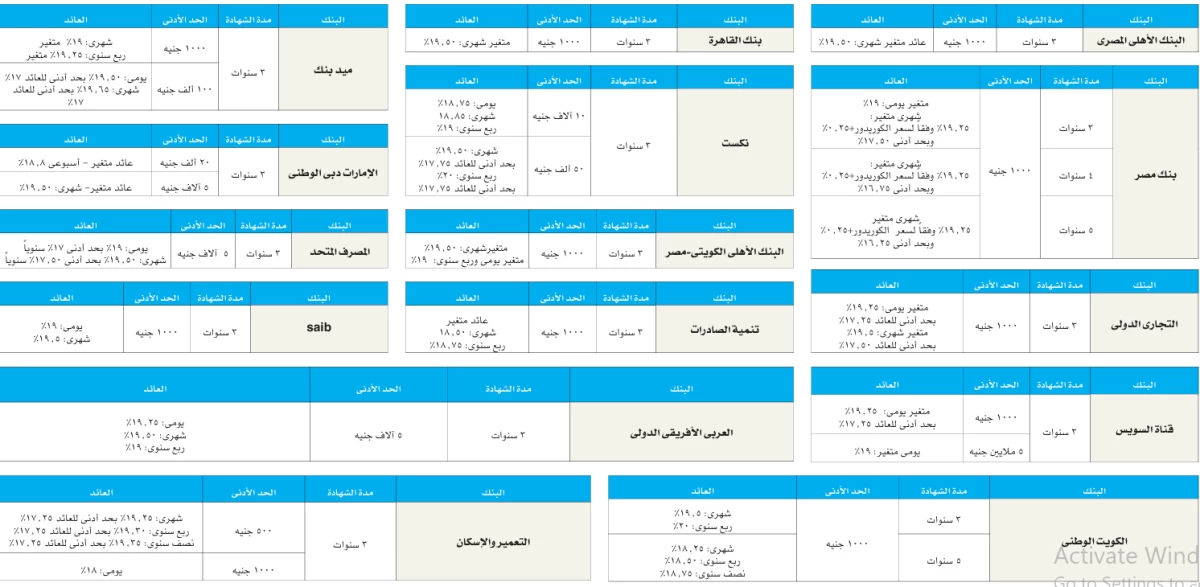
In response to the Egyptian Central Bank's decision to maintain interest rates at 19% for deposits and 20% for loans, 15 Egyptian banks are competing to attract customer savings through variable-return savings certificates. These certificates offer diverse products with daily, monthly, and different periodic payouts, and vary in minimum purchase limits and redemption conditions. This variety reflects the range of options available to savers. The certificates' appeal stems from their returns being linked to the Central Bank's deposit rate, currently at 19%.
The savings certificates have different periodic payouts, including daily, monthly, quarterly, semi-annual, and annual options, providing customers with greater flexibility to choose what suits their financial needs and plans. For instance, a customer who invests 100,000 Egyptian pounds in a savings certificate with a variable return of 19.50% can expect an annual return of 19,500 pounds, equivalent to around 58,500 pounds over three years. This competitive environment has prompted banks to innovate and offer attractive terms to savers.
The National Bank of Egypt offers a three-year platinum certificate with a variable return of 19.50%, paid monthly, with a minimum purchase limit of 1,000 pounds. The bank's certificate is a popular option among savers due to its competitive return and flexible terms. In contrast, Bank of Egypt provides a certificate with a daily variable return of up to 19%, also with a minimum purchase limit of 1,000 pounds, and allows redemption after a six-month holding period.
Other banks, including private and government-owned institutions, are also offering competitive savings certificates with variable returns. These certificates often require customers to open a current or savings account with the bank and provide basic documents, such as a valid national ID, proof of income, and a recent utility bill. The range of options available to savers has increased significantly, with banks seeking to attract deposits in a competitive market.
According to a survey of several government and private banks, the minimum purchase limit for savings certificates varies, and some banks offer more flexible redemption conditions than others. For example, some banks allow customers to redeem their certificates after a certain holding period, while others may impose penalties for early redemption. This variability reflects the different strategies employed by banks to attract and retain savers.
The Egyptian Central Bank's decision to maintain interest rates has created a stable environment for banks to offer competitive savings certificates. The Central Bank's deposit rate, which serves as a benchmark for savings certificate returns, has remained unchanged at 19%. This stability has encouraged banks to focus on offering attractive terms and conditions to savers, rather than competing solely on interest rates.
The competition among Egyptian banks to attract customer savings through variable-return savings certificates is expected to continue, driven by the growing demand for savings products and the need for banks to maintain liquidity. As the banking sector continues to evolve, savers are likely to benefit from a wider range of options and more competitive terms, ultimately enhancing their financial planning and savings goals.
Key points
- The Egyptian Central Bank's decision to maintain interest rates at 19% for deposits and 20% for loans has led to increased competition among banks to offer attractive savings certificates with variable returns.