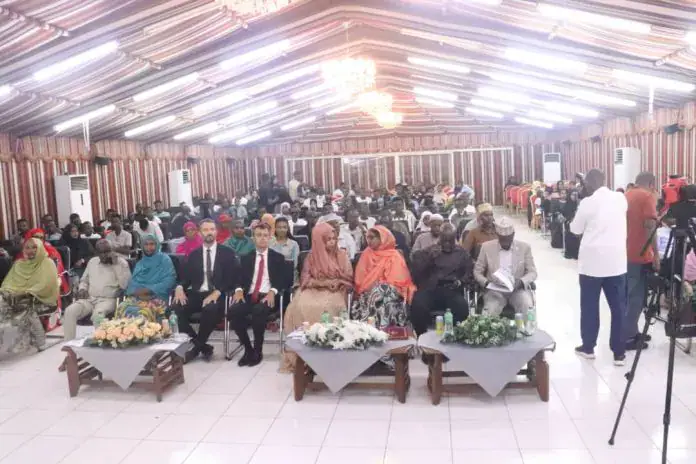
In a ceremony held at the Al Rahma complex in Balbala, 118 young people from the Layabley and Moustiquaire neighborhoods received certificates of vocational training. The training program, part of the Projet de développement urbain intégré II ter (PDUI 2-ter), was implemented by the Agence djiboutienne de développement social (ADDS) with support from the Agence française de développement (AFD). The program aims to provide young people with skills to integrate into the workforce and become economically independent.
The 118 beneficiaries, including 42 young women and 76 young men, underwent training in 12 different fields, including port logistics, transportation, computer science, building construction, and services. The training programs, which lasted between one and a half months and nine months, were provided by three institutions: the Centre de ressources et de compétences des métiers portuaires, du transport et de la logistique (CRC-MPTL), WILO TECH, and the Centre d’action sociale et d’autonomisation des femmes (CASAF).
The PDUI 2-ter program is part of a larger partnership between ADDS and AFD, worth 24 million euros, aimed at transforming the peripheral neighborhoods of Balbala. The program includes not only vocational training but also infrastructure development, such as roads, water networks, and public equipment. According to Galab Hassan Galab, director of social development at ADDS, the program represents a strategic investment in the future of young people in Balbala.
The training programs were designed to meet the needs of the Djiboutian job market, with a focus on sectors such as port logistics, regional logistics, digital technology, and services. The program's goal is to provide young people with the skills and qualifications needed to access employment and become economically independent. Hamda Said Abdi, one of the young women who received a certificate, expressed her determination to break down barriers in male-dominated professions.
The ceremony was attended by several high-ranking officials, including the Minister of Social Affairs and Solidarity, Ouloufa Ismail Abdo, the Minister of Youth and Culture, Fardoussa Moussa Egueh, and the French Ambassador to Djibouti, Jérôme Bresson. The event highlighted the importance of vocational training in addressing the challenges of unemployment and poverty in Balbala.
The PDUI 2-ter program is part of a broader effort to reduce territorial inequalities and improve living conditions in Balbala. According to Jérôme Bresson, the French Ambassador to Djibouti, the program represents a significant investment in the future of young people in Balbala, with a total budget of around 24 million euros. The program has already achieved significant results, including the construction of four kilometers of roads and 5.5 kilometers of water networks.
The program's focus on vocational training and economic autonomy reflects a shift towards more sustainable and empowering approaches to development. As Mohamed Hassan Saïd, president of the Balbala commune, noted, the certificates received by the young people represent not only the end of a training program but also a new perspective on their future. The program's impact is expected to be long-term, with the potential to transform the lives of young people in Balbala and contribute to the country's economic development.
Key points
- The program aims to provide young people with skills to integrate into the workforce and become economically independent.
- The training programs were designed to meet the needs of the Djiboutian job market.
- The program represents a significant investment in the future of young people in Balbala, with a total budget of around 24 million euros.