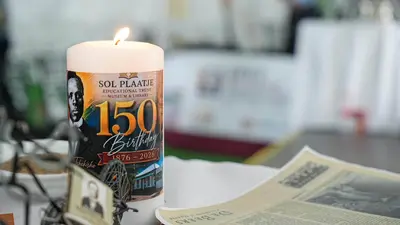
Today, South Africa commemorates the 150th birthday of Solomon Tshekisho Plaatje, a multifaceted figure who challenged colonial power and gave black South Africans new tools to fight injustice. Plaatje was a journalist, novelist, linguist, political organiser, musician, and Setswana philosopher. His work continues to inspire scholarship, with recent PhD theses emerging from the University of the Witwatersrand. These studies explore Plaatje's journalism, his collection of Setswana proverbs, and their significance in understanding black life in South Africa at the turn of the 20th century.
Plaatje's journalism career began as a court interpreter during the siege of Mafeking in October 1899. He witnessed firsthand the suffering of black people, who were dying from starvation-related illnesses while British garrison horses were fed and white civilians were rationed. This experience led him to write the Mafeking Diary, a foundational act of investigative journalism that documented the lives of black South Africans. The diary, published in 1973, more than 70 years after it was written, established that black South Africans would document their own history and challenge the narrative that sought to erase them from the official record.
In 1902, Plaatje founded Koranta ea Becoana, the first wholly black-owned and controlled newspaper in South Africa. Funded by Silas Molema of the Barolong chiefly family, the newspaper received no subsidy from white political parties or business backers, ensuring its independence. Koranta ea Becoana conducted investigative journalism, including coverage of railway discrimination, South African War compensation, native tax documentation, and franchise guides. This work anticipated the formalisation of investigative journalism as a professional genre in North American scholarship by two decades.
Plaatje's newspaper, Koranta ea Becoana, had two languages and two philosophies: English and Setswana columns that presented different arguments for different audiences. In his Setswana columns, Plaatje deployed an African philosophical framework that operated outside the colonial tradition's frame of reference. This approach allowed him to challenge the colonial state in ways that European philosophical traditions could not access or refute. Scholars have noted that accounts of Plaatje's political thought did not fully consider his Setswana columns, demonstrating the significance of African languages in containing philosophies that can challenge dominant narratives.
One notable column in Koranta ea Becoana was the Maitisho column, written in a female voice and addressed to the women of the Setswana community. The column discussed issues such as marriage, colonial disruption of Setswana domestic life, and the erosion of female authority. Scholars speculate that the column was Plaatje's voice, adopting a female editorial persona to address topics that a male editor could not discuss within the social conventions of the era. The Maitisho column produced a sustained feminist political journalism that preceded many equivalents in the South African black press by decades.
Plaatje's work played a crucial role in the early liberation movement. He was selected as the general secretary of the South African Native National Congress (SANNC), founded on 8 January 1912, and later became the organ of the organisation through his newspaper, Tsala ea Batho. The newspaper published SANNC resolutions, analysed parliamentary debates, and provided a communication infrastructure for the liberation movement. In June 1913, Tsala ea Batho published an editorial that instructed civil disobedience, demonstrating Plaatje's influence on the theory of civil disobedience in South Africa.
As South Africa reflects on Plaatje's legacy, it is clear that his work continues to shape the country's intellectual and civic life. His commitment to investigative journalism, African philosophical frameworks, and feminist political journalism has left a lasting impact. The reappraisal of Plaatje's place in history as an important thinker is underway, and his contributions to the liberation movement and African governance claims continue to inspire new generations of scholars and activists.
Key points
- Plaatje's Mafeking Diary established that black South Africans would document their own history and challenge the narrative that sought to erase them from the official record.
- Koranta ea Becoana, founded by Plaatje, was the first wholly black-owned and controlled newspaper in South Africa, conducting investigative journalism that anticipated the formalisation of the genre in North American scholarship.
- Plaatje's work in the Setswana columns of Koranta ea Becoana deployed an African philosophical framework that operated outside the colonial tradition's frame of reference, challenging the colonial state in ways that European philosophical traditions could not access or refute.