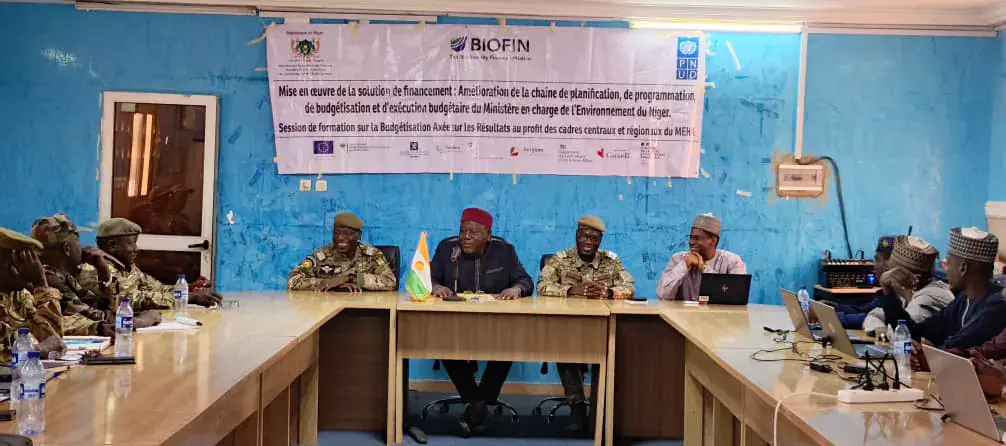
The Nigerien government's efforts to enhance environmental conservation have received a boost from the United Nations Development Programme (PNUD). On November 10, 2026, the secretary general of the Zinder region, Abou Idrissa, opened a training workshop aimed at improving the planning, programming, budgeting, and execution of the Ministry of Environment, Hydraulics, and Sanitation. This initiative is part of the Biodiversity Finance Initiative (BIOFIN), supported by the PNUD and funded by the Kingdom of Belgium.
The workshop, held at the Zinder governorate, aims to strengthen the capacity of ministry officials to integrate biodiversity conservation into public policies and budgets. Colonel Ibrahim Moustapha, the Zinder regional director of environment, welcomed participants and highlighted the importance of biodiversity in achieving environmental goals. Dr. Boubacar Moundjo, BIOFIN coordinator and PNUD representative, emphasized that Niger's rich natural heritage requires sustainable financing mechanisms to ensure its preservation.
Niger joined the Biodiversity Finance Initiative in 2023 to mobilize additional resources, optimize public spending, and direct investments towards biodiversity conservation and sustainable development priorities. The initiative has enabled Niger to develop a biodiversity financing plan with 14 solutions, including one prioritized solution to improve the ministry's planning, programming, budgeting, and execution chain. This solution involves providing training modules on result-based budgeting, adapting manuals for 130 ministry officials, and supporting the preparation of programmatic and budget documents.
The training aims to improve the quality of planning and budget management, enhance sectoral actor capacities, and promote better integration of environmental concerns into public budgets. Dr. Moundjo expressed hope that the training will contribute to more effective environmental conservation. The secretary general of the Zinder region, Abou Idrissa, contextualized the initiative within Niger's ongoing refoundation efforts, emphasizing the importance of sovereign and transparent management of national resources.
Idrissa highlighted that environmental protection is not only a conservation issue but also a sovereignty concern, as ecosystems underpin economic development and food security. He stressed the need for technical tools and competencies to ensure effective planning, coherent programming, and proper budget execution. The workshop brings together officials from the Ministry of Environment, Hydraulics, and Sanitation to enhance their skills in budget planning and execution.
The PNUD's support for Niger's environmental conservation efforts aligns with the country's commitment to protecting its natural heritage. The Biodiversity Finance Initiative has been instrumental in helping Niger develop a structured financing plan for biodiversity conservation. The training workshop in Zinder is a significant step towards building the capacity of ministry officials to manage budgets effectively and prioritize environmental conservation.
The event concluded with a call to action for participants to apply the skills and knowledge gained to improve budget planning and execution in the Ministry of Environment, Hydraulics, and Sanitation. The PNUD's initiative is expected to have a positive impact on Niger's environmental conservation efforts, ensuring a more sustainable future for the country's rich natural heritage.
Key points
- PNUD supports Niger's Environment Ministry with budget planning and execution training
- The training aims to improve the quality of planning and budget management, enhance sectoral actor capacities, and promote better integration of environmental concerns into public budgets.
- Niger joined the Biodiversity Finance Initiative in 2023 to mobilize additional resources, optimize public spending, and direct investments towards biodiversity conservation and sustainable development priorities.