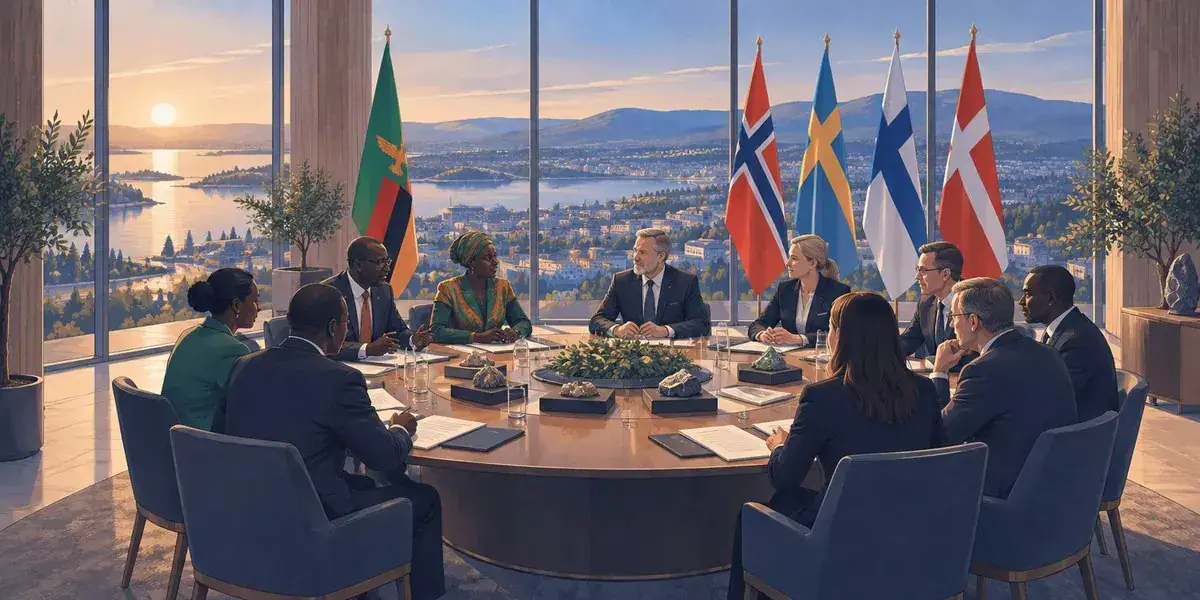
Zambia's diplomatic efforts to attract investment in the critical minerals sector have taken a new turn, with the country actively courting Nordic capital for downstream industrial activity. Etambuyu Anamela Gundersen, Zambia's permanent secretary for international relations and cooperation, made a pitch at a sustainable critical-mineral value chains roundtable in Oslo on 20 November 2026. The meeting was attended by Nordic government representatives, industry figures, and foreign ministers from Tanzania, Malawi, Ghana, and the Democratic Republic of the Congo.
Gundersen framed Zambia's offer around shared value creation, highlighting rising demand driven by the green-energy transition, digitalisation, and advanced manufacturing. The government wants partners who will build processing capacity and transfer technology, not simply extract copper, cobalt, and manganese and ship them out. Joint ventures and long-term industrial agreements are the preferred vehicles for partnerships. Nordic countries bring expertise in sustainable mining, green technology, and advanced manufacturing, while Zambia counters with mineral resources, expanding domestic markets, and a growing workforce.
Zambia is positioning itself as a leading copper producer and an emerging supplier of cobalt, manganese, and nickel, all materials central to battery supply chains and clean-energy infrastructure. The country's policy direction is deliberate, with a focus on supporting processing, industrial research, and local manufacturing. By linking resource access to technology transfer, skills development, and production capacity in a single framework, Zambia's proposal is an industrial policy pitch as much as a minerals play.
The Oslo pitch sits squarely within President Hakainde Hichilema's Grow Zambia Agenda, which prioritises value addition, exports, industrialisation, and employment through private-sector partnerships. For investors, the message goes well beyond mining permits, with Zambia seeking capital across mineral processing, energy development, and related industrial services. The addressable opportunity extends across the supply chain, with Gundersen also calling for university partnerships, research cooperation, and technical training.
Industry-led skills development and exchange programmes were included in the ask, which could support local capability as projects scale. Zambia's approach mirrors wider African competition for advanced-economy partners, with regional rivals moving quickly to secure partnerships. Kenya's selection of the Frontier Minerals Consortium as preferred bidder for the Mrima Hill niobium and rare-earths project is a case in point.
The partnership between Zambia and Nordic nations has the potential to create new opportunities for investors, with the country's growing workforce and expanding domestic markets providing a solid foundation for growth. As Zambia continues to position itself as a key player in the critical minerals sector, the country's focus on downstream processing and manufacturing is likely to attract interest from Nordic investors looking for sustainable and responsible investment opportunities.
As the competition for advanced-economy partners heats up in Africa, Zambia's proactive approach to securing partnerships in the critical minerals sector is likely to pay dividends. With its rich mineral resources and growing economy, the country is well-placed to benefit from the growing demand for critical minerals driven by the green-energy transition and advanced manufacturing.
Key points
- Zambia seeks partnerships with Nordic nations for downstream mineral processing and manufacturing.
Reporting sources
- Zambia critical minerals pitch targets Nordic industry · FurtherAfrica