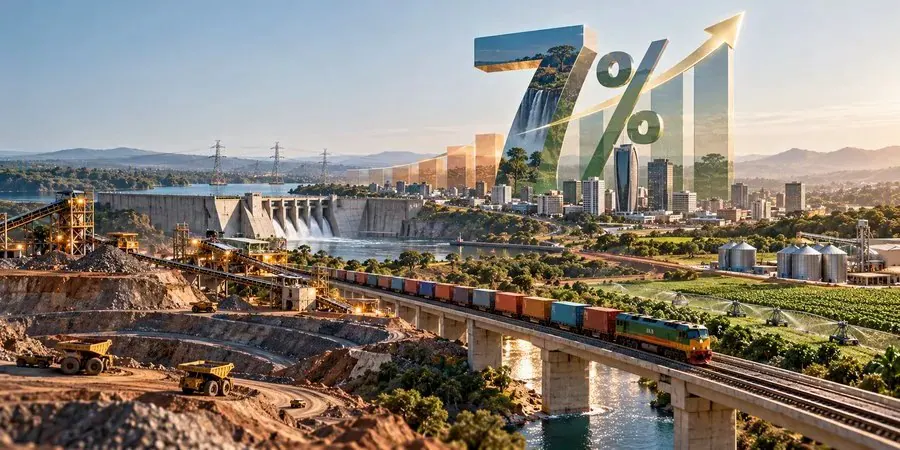
Zambia's economic growth is expected to accelerate to 7% annually by 2029, as the government shifts its focus from debt restructuring to investment-led expansion. The Ministry of Finance has published its 2027-2029 medium-term budget framework, projecting GDP growth of 6.0% in 2027, 7.5% in 2028, and 7.1% in 2029. This growth path implies an average of roughly 6.9%, aligning with the government's stated 7% target. The framework signals a deliberate pivot towards a growth agenda anchored in real sectors.
The growth agenda is driven by key sectors such as agriculture, mining, construction, wholesale and retail trade, information and communication technology, and financial services. Each sector presents a distinct opportunity for both domestic and foreign capital. The government's focus on these sectors aims to attract investment and stimulate economic growth. By prioritizing these areas, Zambia aims to diversify its economy and reduce its reliance on a single industry.
The International Monetary Fund (IMF) has set a more cautious benchmark for Zambia's economic growth, projecting an expansion of 4.3% in 2026. In contrast, the government's 2026 budget had projected 6.4% growth. This gap highlights the execution challenge facing policymakers, who must translate debt-restructuring progress into productive public spending and private-sector confidence.
Achieving the 7% growth target has significant implications for investors. Faster expansion would support several market-relevant outcomes, including increased tax receipts, compressed debt-to-GDP ratios, and growing demand for domestic financial instruments. These effects would compound over a three-year horizon, making Zambia an attractive investment destination.
The energy sector is also crucial to Zambia's growth story, with Mercuria and Exergy Energy recently signing a $250 million financing deal to support power generation and transmission projects. This deal signals that institutional capital is already repositioning around Zambia's growth story, pending regulatory approvals.
Mining output will remain a critical variable for Zambia's economy, as copper prices and production volumes directly affect export receipts and fiscal headroom. Construction and ICT offer domestically driven demand that is less exposed to commodity cycles, providing a stable foundation for growth.
Investors should monitor several key milestones over the next 24 months, including debt-restructuring agreements, the 2027 budget, and evidence of broad-based output growth across agriculture and manufacturing. A single-sector story is fragile, and diversified expansion is essential for durable growth. Zambia's 2028 growth peak of 7.5% will be closely watched by institutional investors, who will test it against delivery data.
Key points
- Zambia targets 7% annual economic growth through 2029.
- The growth agenda is driven by key sectors such as agriculture, mining, and construction.
- Achieving the 7% growth target has significant implications for investors, including increased tax receipts and compressed debt-to-GDP ratios.