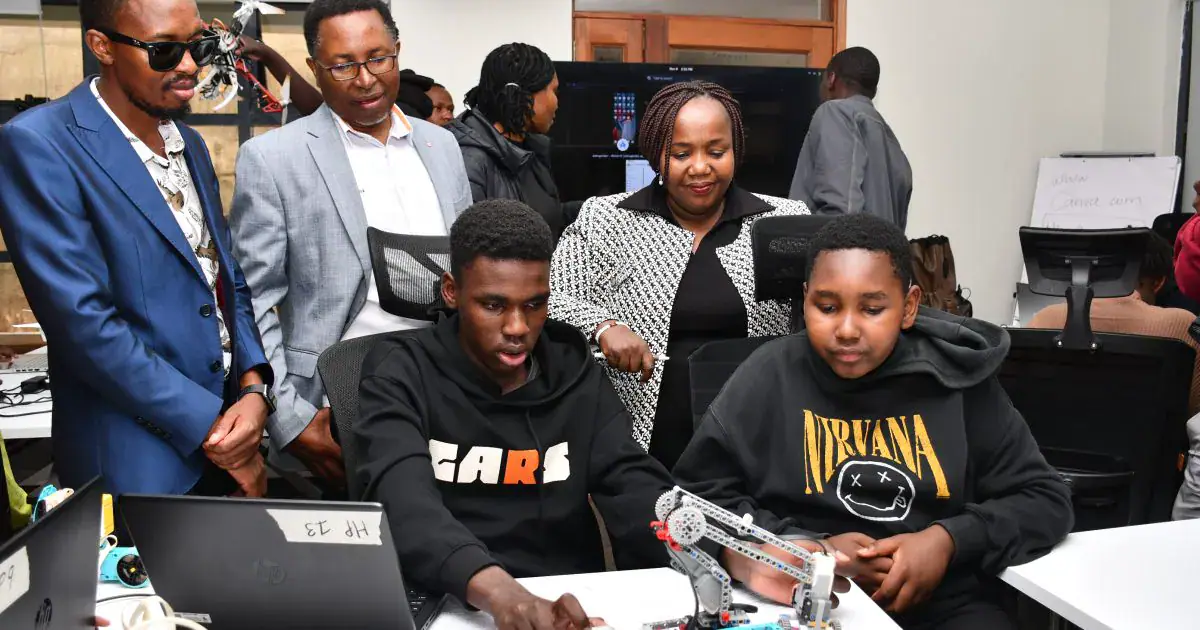
Young innovators in Kenya are embracing technology to address everyday challenges by developing practical solutions that transform how communities manage resources, access information, and tackle societal problems. Through the Centre for Mathematics, Science and Technology Education in Africa (CEMASTEA) STEM Boot Camps, learners are acquiring skills to harness emerging technologies, including coding, robotics, and Artificial Intelligence (AI). These skills enable them to make life easier, improve service delivery, and create solutions to human problems.
Fifteen-year-old Allysa Pendo is among the young innovators turning this ambition into reality. She is leading a team of learners at the CEMASTEA STEM Boot Camp to develop an automated Smart Dustbin designed to minimise contamination from toxic waste. Built using Arduino microcontrollers and programmed through coding, the dustbin incorporates a proximity sensor that detects solid waste and automatically opens its lid, reducing direct contact, preventing the spread of infections, and promoting hygiene.
Thirteen-year-old Emmanuel Anderson has developed an interactive mobile application with different subjects and topics, enabling learners to select specific areas they wish to revise or access learning materials. His ambition is to explore ways of making learning more engaging through technology for learners to understand better. He hopes to develop a mobile application that connects young learners to an interactive digital library filled with educational and entertaining content.
The learning journey for these young innovators begins with basic concepts such as algorithms, commands, and sequences, using familiar everyday examples to simplify coding and introduce learners to computer programming. Pendo and Anderson are among 57 learners who completed an interactive five-day STEM boot camp at CEMASTEA, which provided practical exposure to coding, robotics, Artificial Intelligence, and other emerging technologies.
The Coordinator of the Kenya Science and Engineering Fair (KSEF) in the Ministry of Education (MoE), Tabitha Kariuki, challenged young innovators to focus on developing solutions to everyday challenges within their communities. Kariuki observed that technology had become central to communication, innovation, and development, making digital literacy an essential skill for the next generation.
The Coordinator of STEM Programmes at CEMASTEA, Makoba Kizito, said coding was an essential skill under the Competency-Based Education (CBE) curriculum and in the rapidly evolving technological environment, where Machine Learning (ML) and Artificial Intelligence (AI) were becoming increasingly important. Kizito noted that the Boot Camp was designed to nurture learners into logical thinkers, effective collaborators, and problem-solvers capable of developing solutions to emerging societal challenges.
For Pendo and Anderson, their experience and interest in technology have demonstrated how coding can enhance creativity, collaboration, and understanding of STEM subjects. They, along with other young innovators, are expected to continue developing solutions to everyday challenges, transforming their communities and positioning themselves for opportunities in a tech-driven world.
Key points
- Young innovators in Kenya are developing practical solutions to everyday challenges using STEM skills.
- The CEMASTEA STEM Boot Camps provide learners with practical exposure to emerging technologies, including coding, robotics, and Artificial Intelligence.
- Digital literacy has become an essential skill for the next generation of leaders and innovators in Kenya.
Reporting sources
- Young innovators harness STEM to develop homegrown solutions · Kenya News Agency