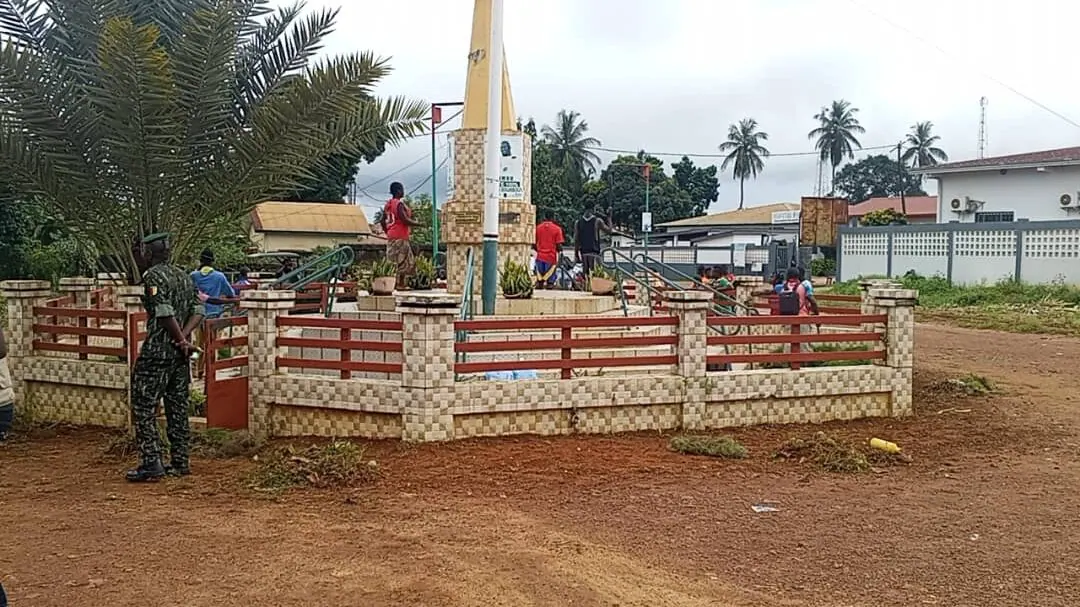
Located in the Nzérékoré administrative region, Yomou prefecture has a long history that dates back to before colonization. The territory was organized into five main traditional cantons: Boo, Nhouna, Nyékoré, Kpinson, and Welapoulou. These cantons played a significant role in the management of community affairs, conflict resolution, and the transmission of ancestral values. The local tradition presents Yomou as the fifth and last capital of the traditional Kingdom of Boo, also known as Kpogho-Nyalowai.
The history of Yomou is closely tied to the Kpelle and Mano populations, two historical communities in the Guinean forest. These populations have developed practices and knowledge related to the forest, land, and watercourses over generations. The prefecture has a rich cultural and natural heritage, including sites considered traditionally sacred, caves, and liana bridges, which are testaments to the ingenuity and skills passed down through generations.
With the colonization of Guinea and the country's independence on October 2, 1958, the territorial organization of the country underwent significant changes. Yomou was established as a prefecture in 1963, as part of the administrative reorganization of the young Republic of Guinea. This evolution marked the gradual transition from an organization based mainly on traditional structures to an administration integrated into the modern territorial organization of the state.
Today, Yomou prefecture comprises the administrative center of Yomou and six sub-prefectures: Diécké, Bignamou, Péla, Bhêta, Banié, and Bowé. For several decades, the prefecture's geographical isolation has been a major challenge to local development. The border location, relief, and climatic conditions have complicated transportation and access to certain localities.
The economic history of Yomou is closely associated with the production of palm oil and palm kernel oil, which has contributed to its reputation as a producer of "red oil." Traditional agriculture has long been the main economic activity of the populations. The cultivation of palm oil, rice, cassava, and other agricultural products has favored the development of an essentially rural economy.
The establishment of the Guinean Palm Oil and Rubber Company (SOGUIPAH) marked a new stage in the prefecture's economic history. The development of palm oil and rubber production has gradually transformed the local economic landscape. Plantations, processing activities, and related activities have contributed to the strengthening of Yomou's agro-industrial vocation.
Yomou remains one of the emblematic territories of the Guinean forest, with an identity based on its traditional heritage, Kpelle and Mano cultures, natural heritage, and agricultural and agro-industrial vocation. Its proximity to Liberia is also an important element of its history and development prospects. From Kpogho-Nyalowai to the modern prefecture of Yomou, the territory has undergone significant administrative, social, and economic transformations while retaining part of its ancestral identity.
Key points
- Yomou prefecture has a rich cultural heritage and history deeply rooted in the traditions of the Guinean people.
- The prefecture's economic history is closely associated with the production of palm oil and palm kernel oil.
- Yomou's identity is based on its traditional heritage, Kpelle and Mano cultures, natural heritage, and agricultural and agro-industrial vocation.