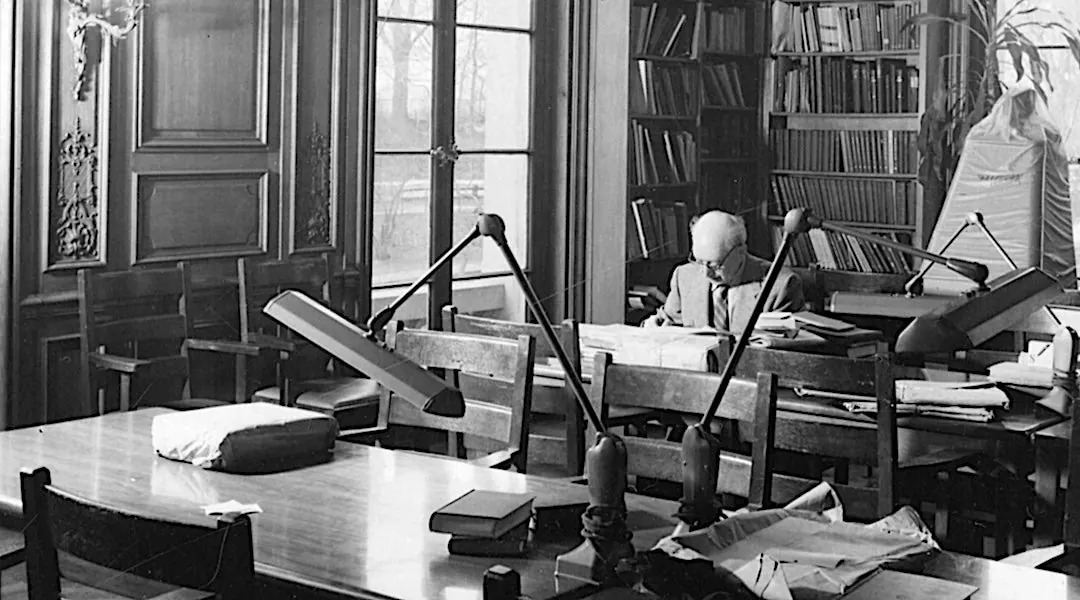
The YIVO Institute for Jewish Research was founded in 1925 in Vilna with a mission to study a living Yiddish culture. Its scholars examined Yiddish language and literature, as well as Jewish sociology, psychology, history, and contemporary life. YIVO aimed to help Jews navigate modernity and understand their daily lives. The institute's founders, including Max Weinreich, envisioned a national university for Jews scattered across Eastern Europe and beyond.
When the Nazis destroyed much of the world YIVO studied, its surviving caretakers had to reevaluate their mission. After World War II, YIVO relocated to New York and became a guardian of a nearly vanished culture, rescuing texts and embracing an American, English-speaking identity. Kalman Weiser's new history, "Yiddish Scholarship Comes to America: The YIVO Institute at 100," explores this transformation. Weiser, a professor at York University in Toronto, focuses on the transitional years from 1940 to 1970.
Max Weinreich, one of YIVO's founders, played a crucial role in the institute's transformation. Stranded in Copenhagen in 1939, he eventually reached New York with his son Uriel and began building the American branch of YIVO. Weinreich drove the transformation, arguing that American Jews would have to assume the burden of world Jewish leadership. The United States had the world's wealthiest and largest Jewish population, and Weinreich believed YIVO had to adapt to this new reality.
YIVO's staff disagreed on its primary mission, with some wanting to preserve the lost world and others focusing on the English-speaking generations growing up in America. The institute undertook a campaign to recover its collections, including rare books, manuscripts, and artworks. The Nazis had looted Jewish libraries and archives, and YIVO worked to retrieve its materials from various locations, including bunkers, a Lithuanian church, and the Offenbach Depot in Germany.
The retrieval efforts raised questions about ownership of cultural heritage. Weiser noted that it was unclear whether the materials should return to their countries of origin, a Jewish community, or the United States. The process extended into the 21st century, and the storage of treasures in New York reflected YIVO's changing mission. The institute moved to a Vanderbilt mansion on Fifth Avenue in the mid-1950s, symbolizing its integration into the American Jewish establishment.
Uriel Weinreich, Max's son, played a key role in YIVO's transition. He became the first professor of Yiddish at Columbia University and helped bring Yiddish scholarship into American universities. Uriel represented a generation that understood America on its own terms, unlike the European Jewish intellectuals who struggled to acclimate. His generation helped lay the foundations for the academic field of Jewish studies.
YIVO trained scholars such as Joshua Fishman, Dan Miron, Ruth Wisse, and Lucy Dawidowicz, but its centrality to the field of Jewish studies waned as scholarship became more part of American academia. Yiddish itself became increasingly marginal to American Jewish life, leading YIVO leaders to debate dropping "Yiddish" from the institute's name in the 1950s. Today, YIVO's project has acquired new urgency as younger Jews reach back to Yiddish as an alternative to traditional models of Jewish identity.
Key points
- YIVO Institute adapted to a new era after World War II, shifting its focus to preserve Yiddish culture and accommodate American Jewish life.
- The institute's transformation was driven by Max Weinreich and his son Uriel, who helped bring Yiddish scholarship into American universities.
- YIVO's efforts to retrieve its collections raised questions about ownership of cultural heritage and reflected its changing mission.