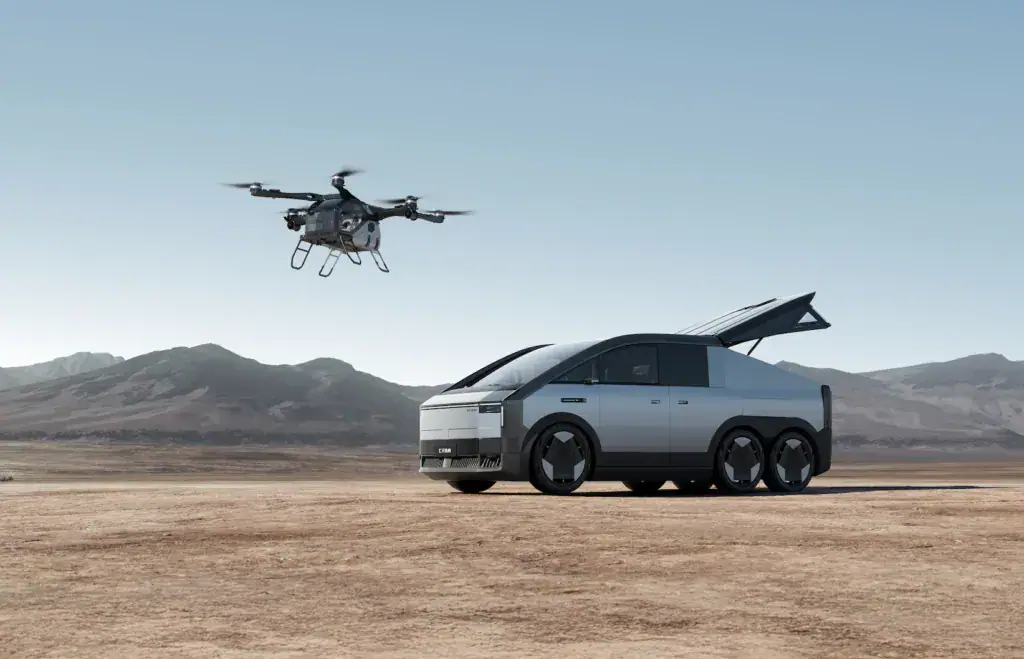
XPENG, a Chinese electric vehicle manufacturer, is expanding its presence in the aerial mobility sector through its subsidiary ARIDGE. Founded in 2013 as AEROHT, ARIDGE was integrated into XPENG's ecosystem in 2020 and adopted its current name in October 2025. The company has been working on flying cars for over 13 years and unveiled its Land Aircraft Carrier, a modular vehicle that combines a six-wheeled terrestrial carrier with a bi-place eVTOL module, at a Brand Night event in Dubai earlier this month.
The Land Aircraft Carrier features an extended-range electric architecture with an 800V system and silicon carbide components, providing over 1,000 km of cumulative autonomy. The eVTOL module offers approximately 30 minutes of flight time and can be recharged in a few minutes. ARIDGE claims that the vehicle has garnered significant interest, with over 7,000 pre-orders globally and 600 orders from companies in the Gulf Cooperation Council. The company aims to start commercial sales in the Middle East in 2027.
To support its industrialization plans, ARIDGE has established a manufacturing facility in Guangzhou, China, with an annual production capacity of 10,000 units. The company is working on regulatory frameworks to enable the deployment of its flying cars. In the UAE, ARIDGE is participating in a pilot project with Ras Al Khaimah, supervised by the GCAA, which includes a demonstration flight between Abu Dhabi and Ras Al Khaimah.
ARIDGE's strategy involves creating a seamless transition between terrestrial and aerial mobility. The Land Aircraft Carrier allows users to detach the eVTOL module and reattach it within minutes, enabling both road and air travel. The company emphasizes the safety features of its vehicle, including a redundant architecture and a multi-parachute rescue system.
XPENG's vision for "Physical AI" encompasses not only electric vehicles but also humanoid robots, robotaxis, and aerial mobility solutions. The company is working on various projects, including IRON, a humanoid robot designed and produced according to automotive industry standards. With over $900 million in funding, IRON aims to achieve mass production by the end of 2026 and commercial deployment in China and internationally in 2027.
ARIDGE's ambitions extend beyond the Land Aircraft Carrier, with the company working on the A868, a six-seat eVTOL aircraft with a range of over 500 km and a maximum speed of over 360 km/h. While no specific launch or commercialization timeline has been announced, ARIDGE aims to establish itself as a pioneer in the public aerial mobility sector.
XPENG's foray into aerial mobility and humanoid robotics reflects its broader strategy to create a comprehensive ecosystem of intelligent vehicles, robots, and mobility solutions. With its expanding presence in the Middle East and Africa, the company is poised to make a significant impact in the region's transportation sector.
Key points
- ARIDGE has received over 7,000 pre-orders for its Land Aircraft Carrier globally.
- The company plans to start commercial sales in the Middle East in 2027.
- XPENG's "Physical AI" vision encompasses electric vehicles, humanoid robots, robotaxis, and aerial mobility solutions.
Reporting sources
- XPENG mise sur ARIDGE pour démocratiser la mobilité aérienne · Challenge Hebdo