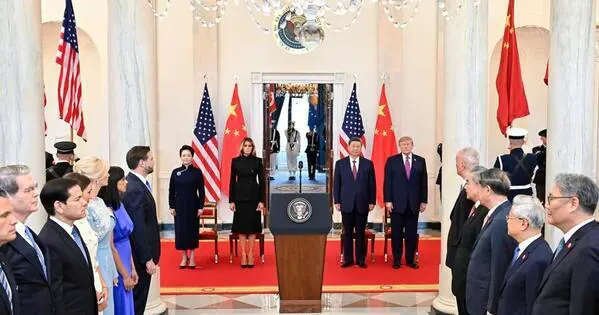
Chinese President Xi Jinping and U.S. President Donald Trump on Thursday honored the history of China-U.S. joint fight against Japanese aggression in WWII. The two leaders recalled the legacy of shared struggle between the two nations during World War II. Xi reflected on the deep ties forged during wartime, saying that the Chinese and American people once stood shoulder to shoulder against fascist aggression. Trump also brought back the shared wartime memory by recalling the history of the U.S. and China fighting alongside each other as allies during World War II.
Xi and Trump invoked a shared historic legacy to strengthen bilateral ties. Xi said that the Chinese people have never forgotten the part of history when the two nations fought together, nor have the American people. Trump praised the Flying Tigers, officially known as the American Volunteer Group of the Chinese Air Force, for their bravery during their joint combat with Chinese soldiers and civilians against the Japanese invasion. The Flying Tigers played a significant role in China's resistance against Japanese aggression.
The term "gung ho" was also mentioned during the meeting between Xi and Trump. Trump noted that it was the United States Marines' encounter with Chinese people that inspired the Marines to adopt a Chinese phrase they still use today, "gung ho." The term originated from the Chinese Industrial Cooperatives movement, also known as the "Gung Ho" movement, launched in the late 1930s to support China's war effort. Trump said that the Marines use it as an expression of great enthusiasm, but in Chinese, it literally means working together.
Xi took a moment to recount the story of the Hump Route at a state dinner hosted by Trump on Thursday evening. The Hump Route was a vital air corridor over the Himalayas that became a wartime lifeline for China. From 1942 to 1945, the route served as a key channel for Allied supplies to support China's resistance against Japanese aggression. The Flying Tigers helped open and safeguard the Hump Route, which was crucial in China's fight against Japanese aggression.
The focus on wartime alliance came right on the heels of Japanese Prime Minister Sanae Takaichi's meeting with Trump at the United Nations General Assembly in New York two days earlier. The meeting between Xi and Trump highlighted the significance of the China-U.S. joint fight against Japanese aggression in WWII. The two leaders emphasized the importance of honoring the legacy of shared struggle between the two nations.
The China-U.S. joint fight against Japanese aggression in WWII marked a significant chapter in the history of bilateral relations. The two nations have maintained strong ties since then, with a focus on cooperation and mutual understanding. The meeting between Xi and Trump demonstrated the continued importance of this historical legacy in shaping China-U.S. relations.
The commemoration of the China-U.S. joint fight against Japanese aggression in WWII serves as a reminder of the shared values and interests between the two nations. As Xi and Trump continue to work together to forge a better future for both nations, the legacy of their joint fight against Japanese aggression in WWII remains an essential part of their bilateral relationship. The two leaders' emphasis on this shared history highlights the significance of cooperation and mutual understanding in their relations.
Key points
- The China-U.S. joint fight against Japanese aggression in WWII marked a significant chapter in the history of bilateral relations.
- The Flying Tigers played a significant role in China's resistance against Japanese aggression.
- The Hump Route was a vital air corridor over the Himalayas that became a wartime lifeline for China.