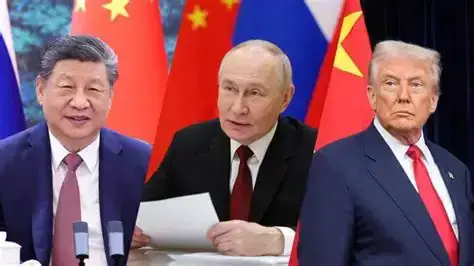
The presidents of China, Russia, and the United States will hold their first trilateral meeting on Thursday, on the sidelines of the Apec summit in Shenzhen. According to Chinese Foreign Ministry spokesperson Mao Ning, the leaders will have in-depth exchanges on preserving global peace and promoting strategic stability in relations between major powers, which she described as having historical significance. The meeting was confirmed by the Kremlin and the White House earlier, and will be attended by Chinese President Xi Jinping, US President Donald Trump, and Russian President Vladimir Poutine.
The trilateral meeting may also touch on the sensitive topic of nuclear arms control. US diplomats have suggested that the discussions could lead to an agreement on the issue, given China's rapidly expanding nuclear arsenal. Washington has called for China to join an agreement on nuclear disarmament, but Beijing has insisted that the US and Russia must reduce their own nuclear arsenals first. The last bilateral nuclear disarmament treaty between the US and Russia, the New Start treaty, expired in February, and Trump has since called for a "better deal" that includes China.
Despite this, Chinese Foreign Minister Wang Yi and US Secretary of State Mike Pompeo agreed in a phone call this week on the importance of substantial conversations at the leaders' level to advance goals such as peace and denuclearization. UN Secretary-General Antonio Guterres also welcomed the trilateral meeting, saying that if the three presidents commit to significant denuclearization, it would be a major breakthrough for the world. Guterres has long advocated for nuclear disarmament, saying that the world will only be fully safe when all nuclear weapons are eliminated.
The war in Iran is also likely to be discussed during the trilateral meeting. Trump said on Sunday that he and his Chinese and Russian counterparts would talk about the issue, and that the US is trying to end the war. China has long sought to play a mediating role in the conflict, which has disrupted global shipping and led to a surge in oil prices. Beijing has received diplomats and leaders from several Middle Eastern countries in recent weeks, and has emphasized the need to avoid a resumption of hostilities.
However, the issue of Russia's invasion of Ukraine may be a sensitive topic during the trilateral meeting. According to the Wall Street Journal, Poutine wants the discussions to lead to a peace agreement in Ukraine that favors Moscow, which launched a large-scale offensive against the country in 2022. However, it is unlikely that Xi or Trump will raise the issue, given China's and Ukraine's concerns. Ukrainian Foreign Minister Andriï Sybiga said that a meeting between the US, Chinese, and Russian leaders would only encourage Poutine to continue the war.
German President Frank-Walter Steinmeier said that Xi Jinping had expressed irritation at the idea of discussing Ukraine during the trilateral meeting. Steinmeier said that Xi had emphasized that the conflict is a European issue that requires European participation in negotiations. This position has done little to reassure Ukraine, which is worried about being left out of the discussions. Sybiga said that Ukraine will continue to seek support from its international partners to address the conflict.
The trilateral meeting between Xi, Trump, and Poutine will be closely watched for signs of progress on global peace and strategic stability. While the leaders are expected to discuss several key issues, including nuclear arms control and the war in Iran, the meeting's outcome is uncertain. The three countries have significant differences on several key issues, and it remains to be seen whether they can find common ground.
Key points
- The trilateral meeting between Xi, Trump, and Poutine will discuss global peace and strategic stability.
- The meeting may also touch on nuclear arms control and the war in Iran.
- The issue of Russia's invasion of Ukraine may be a sensitive topic during the discussions.