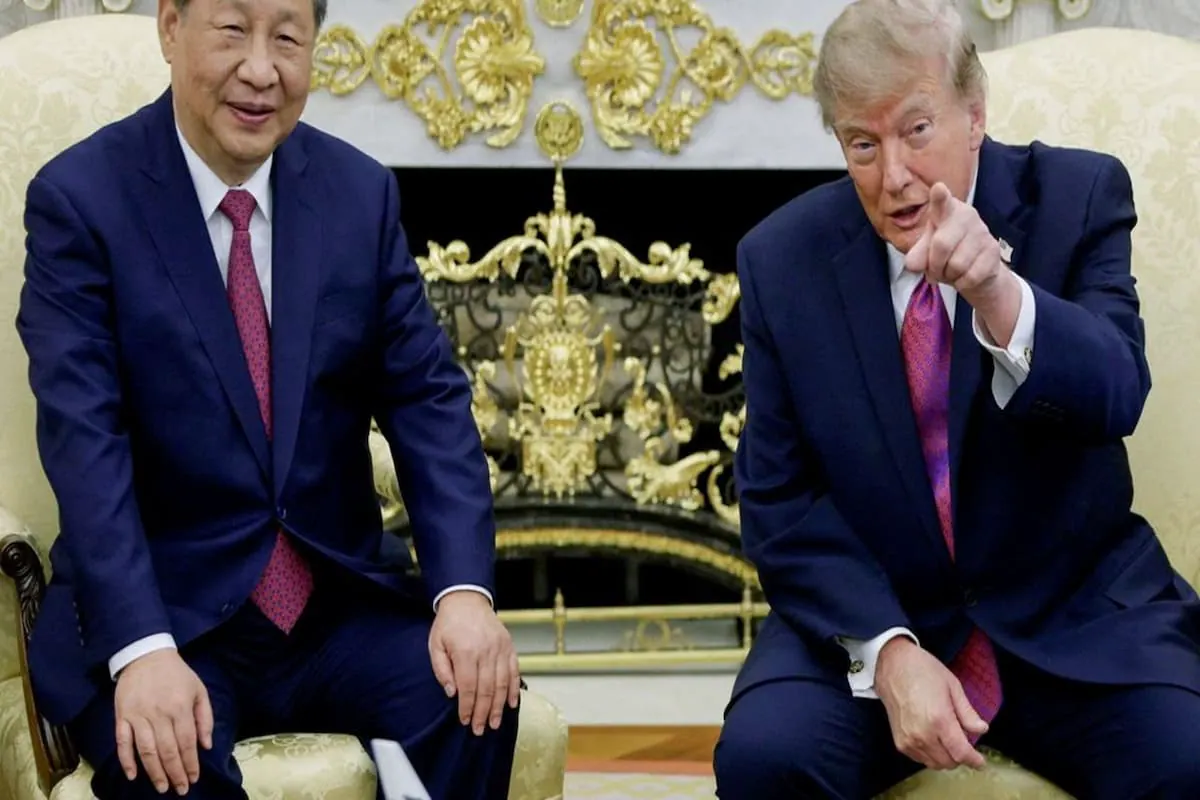
US President Donald Trump welcomed Chinese President Xi Jinping to the White House for a highly anticipated summit. The visit, which took place from September 23 to 25, was marked by a grand ceremony, complete with a military welcome, a fanfare, and a flyover by bombers. The two leaders engaged in a series of high-level talks, but observers noted that the meeting yielded few concrete results. According to Foreign Policy magazine, the most notable outcome was China's announcement of sending two giant pandas to the Atlanta zoo.
Despite the pomp and circumstance, the summit failed to produce significant breakthroughs on key issues, including trade, artificial intelligence, and access to Chinese rare earth minerals. The two nations did agree to extend a trade truce until January 10, but this was seen as largely a confirmation of the current balance of power rather than a major step forward. Some analysts suggested that China may have gained the upper hand, with President Trump facing challenges on multiple fronts, including a protracted conflict in Iran and declining popularity ratings ahead of midterm elections.
The visit was notable for its ceremonial aspects, with President Trump going out of his way to impress his Chinese counterpart. Xi Jinping was treated to a state dinner, a private tea meeting, and a tour of the National Archives. The president also broke with diplomatic protocol by personally greeting Xi Jinping at the airport upon his arrival. This unusual gesture was seen as a reflection of Trump's desire to cultivate a personal rapport with the Chinese leader, whom he has described as a friend.
However, beneath the surface of the friendly rhetoric, tensions between the two nations remain. Key issues, such as Taiwan, the Iran nuclear deal, and competition in artificial intelligence, continue to drive a wedge between Washington and Beijing. During their bilateral meeting, Xi Jinping urged the US to oppose Taiwanese independence, reaffirming China's claim to the island as part of its territory.
The Taiwan issue remains a major point of contention, with China vowing to take control of the island by force if necessary. In a recent gesture of restraint, President Trump suspended a $14 billion arms sale to Taiwan, a move that sparked concern in Taipei and among some Republican lawmakers. It remains to be seen whether this concession signals a shift in the balance of power in favor of China.
Despite these challenges, both sides appeared eager to maintain a veneer of cooperation. The two leaders engaged in a series of friendly exchanges, with Trump describing Xi Jinping as a leader with whom he has "particular affinities." However, analysts note that Beijing is likely to continue pushing for its interests, particularly on issues related to trade and security.
As the two nations look to the future, it remains unclear whether the current truce will hold or if tensions will escalate. With several high-level meetings scheduled, including the APEC summit in China and the G20 in Florida, the stakes are high for both sides to find common ground. For now, the pomp and circumstance of Xi Jinping's visit have given way to the hard realities of great-power rivalry.
Key points
- The US and China agreed to extend a trade truce until January 10.
- The visit was marked by grand ceremonial gestures, including a state dinner and a private tea meeting.
- Tensions between the two nations remain on key issues, including Taiwan and competition in artificial intelligence.