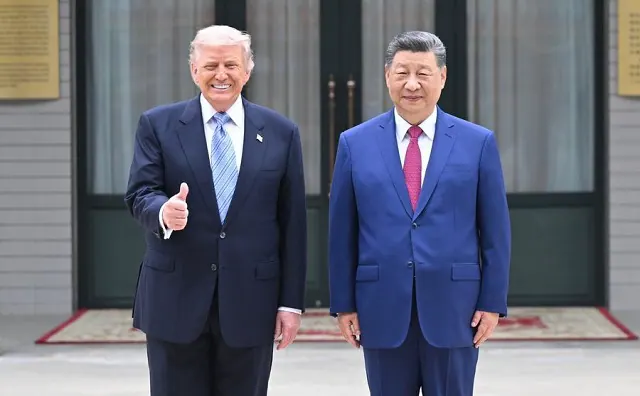
Chinese President Xi Jinping will soon travel to Washington for a state visit and a high-stakes meeting with U.S. President Donald Trump. This trip marks Xi's second state visit to the United States, following his first in 2015. The upcoming visit is expected to complete reciprocal visits between the two presidents within months. The world's most important bilateral relationship has experienced turbulence over the past decade, and how Beijing and Washington manage ties is increasingly consequential for both countries and the world.
During Xi's May visit to Trump in Beijing, he posed three questions: Can China and the United States overcome the Thucydides Trap and create a new paradigm of major-country relations? Can they meet global challenges together and provide greater stability for the world? Can they build a bright future together for their bilateral relations in the interest of the well-being of the two peoples and the future of humanity? These questions were raised against the backdrop of years of turbulence in bilateral ties, from trade disputes to tech curbs.
Xi and Trump have agreed on a new vision of building a constructive China-U.S. relationship of strategic stability over the next three years and beyond. According to Da Wei, director of the Center for International Security and Strategy at Tsinghua University, this marks the first time in more than a decade that China and the United States have established a consensus about how to define the relationship that leaders on both sides broadly recognize. Chinese Foreign Minister Wang Yi emphasized that head-of-state diplomacy is the anchor of China-U.S. relations.
Xi has maintained contact with Trump through various means, including face-to-face meetings and phone calls, since Trump's re-election. During the May visit, Xi invited Trump to Zhongnanhai, the leadership compound in central Beijing, for a private meeting. Xi and Trump strolled in the garden, chatting and pausing to admire the ancient trees and Chinese roses in full blossom. Xi urged both sides to keep to the right direction, steer clear of disruptions, and promote the steady development of bilateral relations.
Economic and trade relations should continue to serve as the "ballast" and driving force for China-U.S. relations, rather than a stumbling block or a point of friction, Xi told Trump in Busan, South Korea, in 2025. Xi has often likened China-U.S. relations to a giant ship, for which ballast is critical to staying on course through rough waters. Following the surge of U.S. tariffs in 2025, Beijing responded with resolute countermeasures while continuing negotiations with Washington.
Xi has repeatedly stressed that there is no winner in a trade war, both in his exchanges with Trump and on the international stage. He also emphasized that decoupling and cutting off supply chains will not hold back China's development process. Xi has reached out to the American business community, meeting with representatives from U.S. business, strategic, and academic communities in Beijing in March 2024. He told the gathering that the respective success of China and the United States is an opportunity for each other.
The foundation of China-U.S. relations was laid by the two peoples, according to Xi. He has encouraged American university students to foster greater mutual understanding and affinity between people of the two countries, promoting the steady and sustained development of bilateral relations. As China-U.S. relations were at a low ebb, Xi looked toward the future – young people – believing they carry the future and hope of this relationship.
Key points
- The meeting between Xi Jinping and Donald Trump aims to stabilize China-U.S. relations.
- Economic and trade relations are crucial for China-U.S. relations.
- Xi Jinping emphasizes the importance of people-to-people relations in fostering a positive China-U.S. relationship.