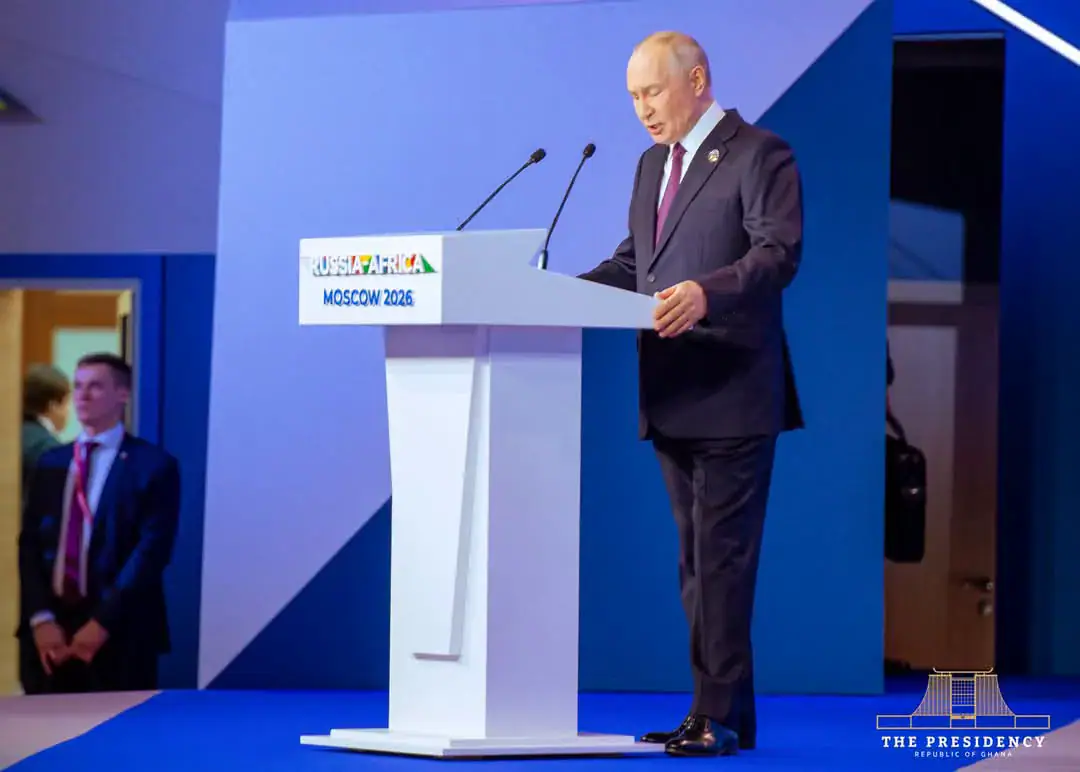
Russian President Vladimir Putin has stated that a multipolar world order is becoming a reality, marking the end of an era where global decisions were made by a small group of countries. He made these remarks at the Russia-Africa Economic and Humanitarian Forum in Moscow, attended by President John Dramani Mahama and other African leaders. Putin emphasized that this trend is objective and irreversible. The forum aimed to promote free and open dialogue, reflecting the significant changes in global affairs.
According to President Putin, the BRICS countries have accounted for over 40% of global GDP in the past five years, surpassing the Group of Seven (G7) countries, which accounted for less than 30%. He predicted that the balance would continue to shift in favor of developing countries. Africa, in particular, is increasingly asserting itself as a major force in global economic and political affairs, with growing sovereignty and influence.
President Putin noted that Africa is experiencing a new awakening, with its sovereignty growing stronger, and its influence and standing on the world stage increasing. He stated that Africans are determined to defend their interests, shape their future, and choose their own paths of development. Putin quoted Thomas Sankara, the late President of Burkina Faso, who described debt as a form of neo-colonialism.
President Putin argued that debt, under conditions dominated by imperialism, could be used to constrain Africa's growth and development. He emphasized that Russia is committed to supporting Africa's development and is a major supplier of agricultural products to the continent. Over 40 African countries receive Russian fertilizers and grain, with Russia exporting around 13 million tonnes of agricultural products to Africa in the first nine months of 2026.
President Putin also offered to share Russian expertise in technology and digital innovation with African countries, which could help strengthen technological capabilities across the continent. He highlighted the importance of improving access to affordable, sustainable, and environmentally friendly energy sources and developing domestic energy markets in Africa. Russia is already working on over 30 energy projects in 16 African countries.
On education, President Putin reported that the number of African students studying in Russia has increased by 50% since 2020, while the number of Russian scholarships available to African students has almost tripled. Around 40,000 African students are currently studying at Russian universities, with the scholarship quota for the 2026-2027 academic year rising to 5,500 places.
The Russia-Africa Economic and Humanitarian Forum provides a platform for discussions on trade, energy, technology, peace and security, and sustainable development, as Russia and African countries seek to deepen their relations. President Putin emphasized that Russia is interested in expanding trade, economic, and humanitarian cooperation with all African countries. The two-day forum concluded on October 29, 2026.
Key points
- A multipolar world order is emerging, with the era of global decisions being determined by a narrow bloc of countries coming to an end.
- The BRICS countries have accounted for over 40% of global GDP in the past five years, surpassing the Group of Seven (G7) countries.
- Russia is committed to supporting Africa's development, with a focus on trade, energy, technology, and education cooperation.