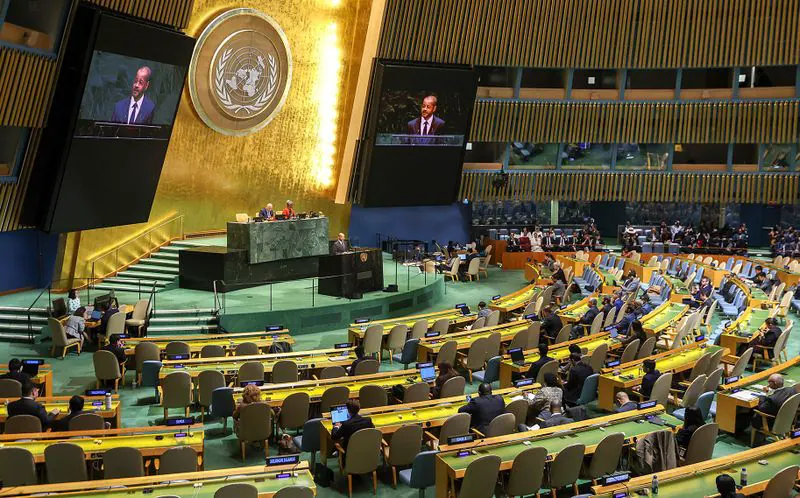
The 81st session of the United Nations General Assembly, held in New York, has demonstrated a shift in the collective mindset of world leaders from anxiety to determination in addressing global challenges, particularly the threat posed by artificial intelligence (AI). According to Mathu Joyini and Claire Melamed, this year's assembly showcased a clear understanding that the world cannot wait for powerful countries to act. The authors noted that the mood among leaders was one of tentative determination to solve collective challenges and uphold international law.
The UN General Assembly offered a snapshot of the world's leaders' collective mindset, revealing a stark contrast to last year's anxiety and uncertainty. The challenges facing the world have not receded; in fact, they have worsened, with an increase in conflicts, deepening geopolitical fragmentation, and emaciated institutions. The accelerating rivalry on frontier technology has added complexity to great power tensions, and the institutions underpinning multilateralism are feeling the strain.
The issue of AI dominated the assembly, with two-thirds of the 194 leaders who spoke mentioning it and the majority insisting on the need for international cooperation. A "Call for Control" of AI was signed by 20 countries at the start of the week, which grew to 30 by the end, including the President of South Africa. The call outlined concrete steps at national, regional, and global levels to address the AI threat.
Leaders recognized the hard-headed reality that cooperation is necessary to defend sovereignty in today's world. They spoke to the abuse of power, sovereign equality of each member country of the UN, and the need for respect of international law. The UN has put together a Scientific Panel to create a collective evidence base and a Global Dialogue to bring all countries and stakeholders together on an equal footing.
The authors noted that there is no single solution to the many challenges faced, but the UN General Assembly showed a clear understanding that the world cannot wait for powerful countries to act. Leaders must work together to find pathways out of the current moment, and the UN is a place where these solutions can be found. The job now is to make the change happen, with leaders needing to carry through their determination in agreements made, money spent, and policies delivered.
The next UN General Assembly will see a new secretary-general in the hall, who will need to hold leaders to their promise that, in the words of Kofi Annan, "whatever our differences, in our interdependent world, we stand or fall together". The determination shown by leaders this year offers some hope and intention, but it remains to be seen if this will translate into tangible action.
The shift in mindset among world leaders is a positive development, but it is crucial that this momentum is maintained and translated into concrete actions. The UN General Assembly has shown that leaders are willing to work together to address global challenges, and it is now up to them to deliver on their promises.
Key points
- World leaders have vowed to tackle the AI threat with determination at the UN General Assembly.
- The assembly showed a clear understanding that the world cannot wait for powerful countries to act on AI.
- Leaders have called for international cooperation and concrete steps to address the AI threat.