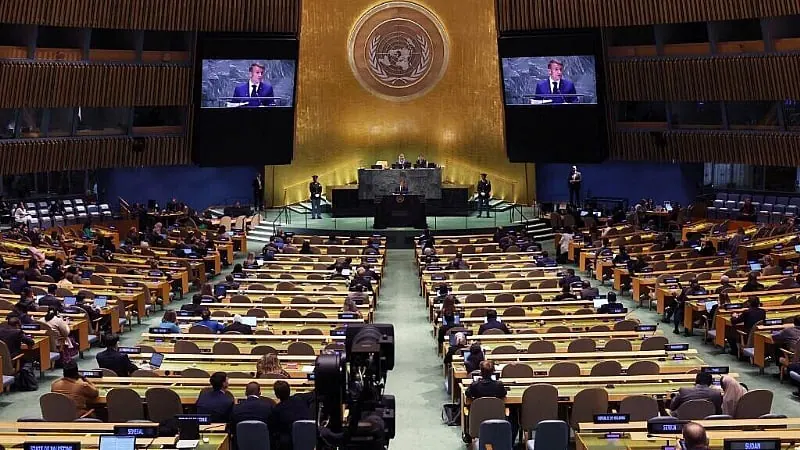
World leaders are converging on New York for the 2026 session of the UN General Assembly, amidst a complex global landscape marked by ongoing conflicts, climate shocks, and rising concerns over artificial intelligence. The gathering, set to feature around 130 heads of state and government, will address pressing issues such as the wars in Ukraine, Gaza, Sudan, the Democratic Republic of Congo, and Myanmar.
The UN's 193 member states have agreed to a broad reform package aimed at updating institutions such as the Security Council, where the US, Russia, China, Britain, and France hold veto powers. However, translating these commitments into concrete changes has proven challenging. The organization is also facing financial pressures, renewed calls for reform, and questions over whether its institutions still reflect the balance of power in the 21st century.
French President Emmanuel Macron and US President Donald Trump are among the leading figures scheduled to speak on Tuesday, following UN Secretary-General Antonio Guterres's opening address on the state of the world. Ukrainian President Volodymyr Zelensky and Iranian President Masoud Pezeshkian are set to speak on Wednesday. Notably, Pezeshkian's visit is complicated by the US refusal to grant visas to members of his communications team.
Several major leaders, including Chinese President Xi Jinping, Russian President Vladimir Putin, and Indian Prime Minister Narendra Modi, are not expected to attend the gathering. Despite these absences, French UN ambassador Jérôme Bonnafont emphasized the importance of the event, stating that it remains an opportunity for countries to demonstrate their support for the organization amid deep international divisions.
The UN has faced a difficult year, with its influence appearing limited in efforts to halt major conflicts, and financial problems forcing cuts to peacekeeping operations and humanitarian aid. The US recently paid $725 million towards its UN dues, easing some immediate pressure and signaling continued engagement with the organization. According to Richard Gowan, director of the International Crisis Group's programme on global issues and institutions, the UN is no longer in "freefall" but remains in a prolonged crisis.
Artificial intelligence has emerged as a major concern during the gathering, with leaders of three major AI companies warning about the possibility of the technology moving beyond human control and calling for a pause in development. The Security Council has added a high-level meeting on AI to its agenda, and experts stress that AI development cannot be left to market whims. Climate change, rising sea levels, education, and gender equality will also feature prominently during the week.
As Guterres prepares to deliver his final General Assembly high-level week address as secretary-general, he emphasized that power is shifting in "an era of deep uncertainty" and that international cooperation is becoming more important rather than less. The gathering will also feature hundreds of bilateral meetings, which can lay the groundwork for agreements reached months later. Esther Brimmer, a senior fellow in global governance at the Council on Foreign Relations, described the global situation in 2026 as "much more serious and complex than in decades past" but expressed hope for international cooperation.
Key points
- Some 130 heads of state and government are expected to address the UN General Assembly amid conflicts, climate pressures, and growing concern over artificial intelligence.
- The UN is facing financial pressures, renewed calls for reform, and questions over whether its institutions still reflect the balance of power in the 21st century.
- Artificial intelligence has emerged as a major concern during the gathering, with leaders calling for a pause in development and international safeguards.