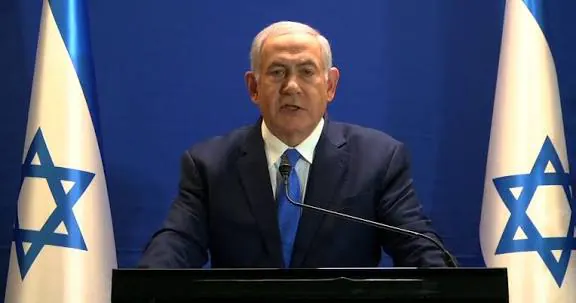
Israeli Prime Minister Benjamin Netanyahu defended his country's military campaigns in a speech to the United Nations General Assembly, prompting dozens of delegates to walk out in protest. Netanyahu vowed to continue Israel's military operations, stating that they have no other choice. He also rejected accusations of genocide in Gaza and criticized delegates who left the chamber, calling them "moral cowards." The speech comes amid growing international criticism of Israel's military campaign and the humanitarian situation in Gaza.
Palestinian President Mahmoud Abbas addressed the assembly via video, criticizing Israel's military operations, settlement expansion, and other policies that threaten the existence of Palestinians and the prospects for a two-state solution. Abbas accused Israel of subjecting Gaza to "killing, destruction, starvation, and attempts at displacement." His remarks come as the Gaza war remains a major focus of the UN gathering. The US had denied Abbas an entry visa, prompting him to address the assembly remotely.
British Foreign Secretary Ed Miliband warned Iran against hostile activity on UK soil during talks with Iranian Foreign Minister Abbas Araghchi on the sidelines of the UN General Assembly. Miliband raised concerns about threats linked to Iran, including attacks targeting Britain's Jewish community, as well as the war in the Middle East and the detention of a British couple in Iran. The meeting also came after reports of a cyberattack that disrupted a small UK power plant in July.
Italy's government has approved measures banning the burqa and niqab in schools and limiting the proportion of pupils with limited Italian language skills in individual classes. The government will impose a 30 percent limit on pupils with poor knowledge of Italian in the first year of primary, middle, and high school. Education Minister Giuseppe Valditara said the measure was based on language ability rather than citizenship.
Canadian Prime Minister Mark Carney said his government has considered the possibility of US military action against Canada, describing it as an extreme risk that Ottawa had a responsibility to prepare for. Carney did not provide details about the measures Canada had taken, but his comments come as Canada has increased defence spending and sought to strengthen its military capabilities, particularly in the Arctic.
Aliko Dangote, Ethiopia, and Djibouti have agreed to develop a $660 million petroleum pipeline and storage project aimed at improving fuel supplies to landlocked Ethiopia. The project includes a 120km pipeline linking Djibouti's Damerjog port to a distribution facility in Dewele, Ethiopia, alongside storage capacity of about 400 million litres. Operations are expected to begin within 18 months.
The Democratic Republic of Congo's North Kivu province has emerged as a growing Ebola hotspot, with treatment centres struggling to accommodate rising cases. The development comes as global leaders continue to address pressing issues at the UN General Assembly.
Key points
- Netanyahu defends Israel's military campaigns at UNGA
- Italy bans burqa and niqab in schools
- Dangote backs $660m Ethiopia Djibouti fuel pipeline project