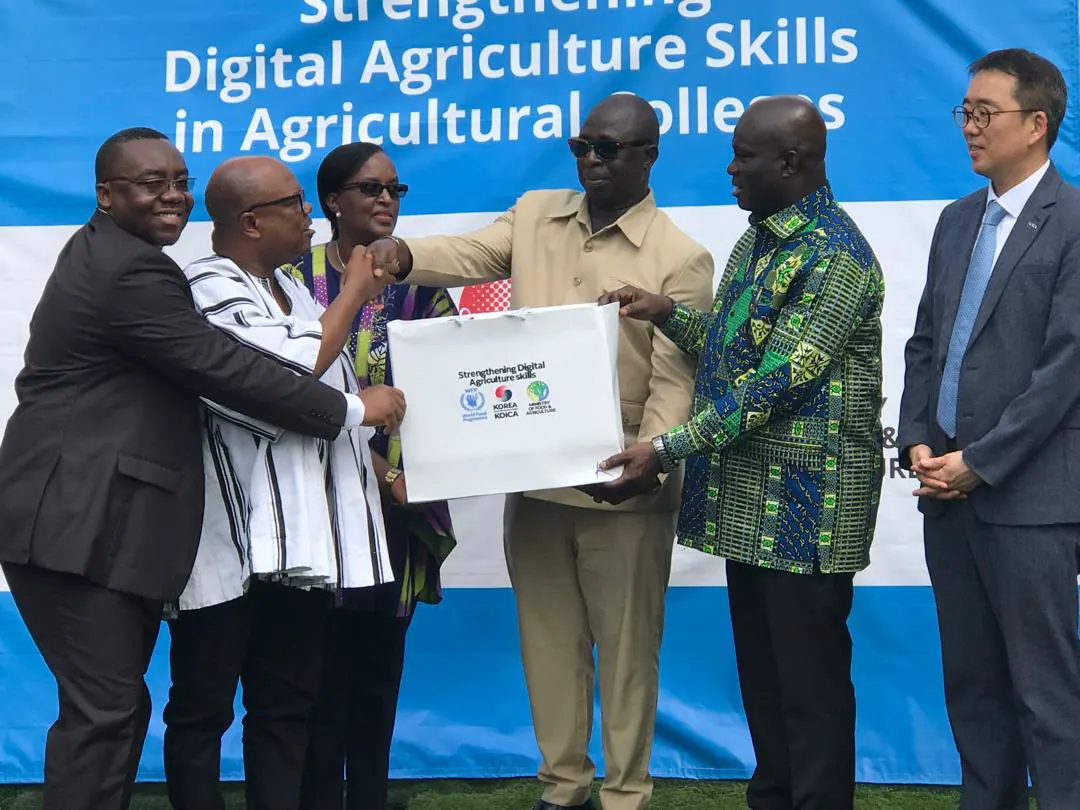
The World Food Programme (WFP), in collaboration with the government of the Republic of Korea through the Korea International Cooperation Agency (KOICA), has provided agritech equipment and tools to five colleges of agriculture in Ghana. The equipment, valued at over half a million dollars, aims to enhance digital agricultural training and equip the colleges with the skills to apply mechanization and technology for efficiency and resilience in the agricultural value chain.
The equipment handed over includes mini drones, GPS for digital mapping, remote weather stations, weather and climate information sensors, grain moisture meters, laptops, soil testers, and greenhouse environmental control learning kits. This initiative seeks to strengthen the capacity of lecturers and instructors to deliver effective training, providing students with practical exposure to precision agriculture, weather, and climate information.
Mr. Eric Opoku, Minister for Food and Agriculture, emphasized the government's commitment to strengthening the capacity of institutions and the skills of graduates to ensure sustainable food systems in Ghana. He noted that investing in knowledge, skills, and innovation in youth would shape the future of agriculture production, attracting professional development and ensuring a practical, modern, and responsive agricultural education system.
Madam Aurore Rusiga, WFP Country Director, highlighted Ghana's progress in agriculture but also noted significant challenges, including post-harvest losses, malnutrition, declining soil health, and production inefficiencies. She emphasized the need to build food systems that can help fight persistent food insecurities and pledged WFP's commitment to partnering with stakeholders to sustain and extend the initiative to other youth.
Mr. Dong Wan Woo, KOICA Country Director, stated that the initiative is part of the KOICA-WFP partnership on youth economic empowerment through digitalization for resilience in food and nutrition security. He stressed the importance of providing young agriculturist students with digital tools to sharpen their skills, boost their confidence, and grow Ghana's agriculture sector.
Mr. Kyoreh Yoo, WFP KOICA Project Coordinator, noted that agriculture remains the backbone of Ghana's economy and primary source of livelihood for most people. He emphasized that digital technology in agriculture is crucial for improving education in agriculture and food sustainability, and that WFP is committed to supporting resilient food systems.
The initiative has been welcomed by the principals of the beneficiary colleges, who believe that the equipment and tools will strengthen hands-on training, prepare students for issues like climate change, and bridge the gap between classroom learning and practical applications. Mr. Albert Appiah Amoako, Principal of Kwadaso Agricultural College, expressed gratitude for the support, which he believes will strengthen the college's capacity to deliver practical training.
Key points
- The World Food Programme and Korean government have invested over half a million dollars in agritech equipment to support five colleges of agriculture in Ghana.