A recent World Bank report has sounded the alarm on Ghana's looming Eurobond repayment obligations, warning that the country must find $6.4 billion to cover principal and interest falling due between 2027 and 2030. This significant repayment wall comes as Ghana tries to rebuild its fiscal credibility after completing a sovereign debt restructuring process. The report, part of the World Bank's October 2026 Africa Economic Update, highlights Ghana's vulnerability among African borrowers.
According to the World Bank update, Ghana is tied with Nigeria for the second-largest Eurobond repayment burden in Africa, with South Africa carrying the heaviest burden at $11.8 billion. Other countries with significant Eurobond repayment obligations include Angola ($3.9 billion), Kenya ($3.2 billion), Côte d'Ivoire ($2.8 billion), and Zambia ($2.2 billion). The report also notes that 2024 was the most concentrated repayment year across the continent, with several countries collectively owing roughly $6.4 billion in maturing Eurobonds.
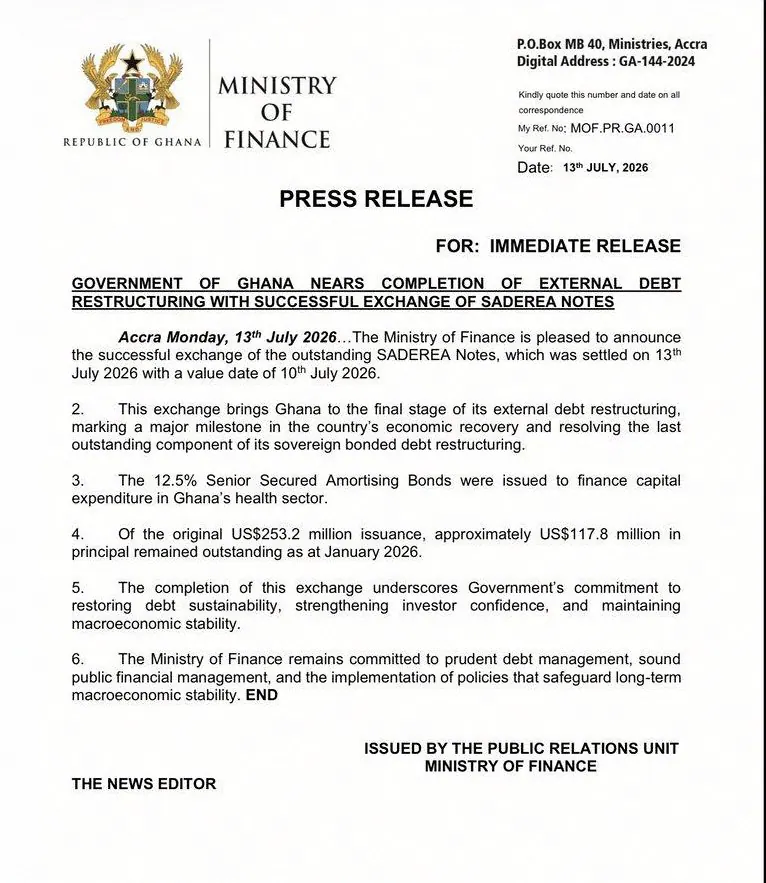
Ghana's recent sovereign debt restructuring process was lengthy and challenging, but ultimately concluded in July 2026 with the exchange of SADEREA Notes worth approximately $117.8 million. On the domestic front, the government has made significant progress, paying GH¢41.36 billion to local bondholders under the Domestic Debt Exchange Programme (DDEP) since 2025. The DDEP was a critical component of Ghana's broader restructuring efforts, aimed at addressing its debt obligations to domestic creditors.
The looming Eurobond repayment burden will likely have significant implications for Ghana's fiscal space, with every cedi allocated to servicing Eurobonds reducing the amount available for essential public expenditures such as infrastructure, healthcare, and salaries. An S&P assessment recently reported that Ghana will devote roughly one-fifth of its government revenue to debt interest, highlighting the strain on the country's finances.
Despite these challenges, there are signs of stabilizing investor confidence in Ghana, with recent Treasury bill auctions oversubscribed by 30 percent and yields trending downward. Additionally, S&P has revised Ghana's outlook to stable, although its credit rating remains in junk territory. It remains to be seen whether this improved sentiment will extend to the Eurobond market, where Ghana will need to refinance or repay billions of dollars from 2027.
The World Bank report does not specify how Ghana intends to meet its Eurobond obligations, leaving the country's strategy unclear. The Ghanaian government has not issued a direct response to the report's findings, and no timeline for a government response has been provided. As Ghana navigates this critical phase, its ability to manage its debt obligations will be closely watched by investors and analysts.
The World Bank's warning on Ghana's Eurobond repayment burden serves as a timely reminder of the country's ongoing fiscal challenges. As Ghana looks to expand spending on its development agenda under President John Mahama, it must carefully balance its financial priorities to ensure that it can meet its debt obligations while also addressing the needs of its citizens.
Key points
- Ghana faces a $6.4 billion Eurobond repayment burden between 2027 and 2030.
- The country's recent sovereign debt restructuring process concluded in July 2026.
- Ghana's fiscal space remains under strain, with significant implications for public expenditures.