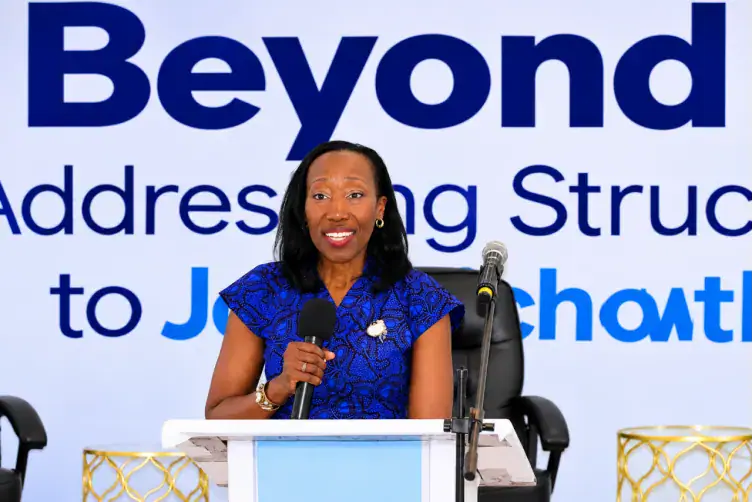
The World Bank has released a report stating that Liberia's economy is growing faster, but most citizens are not feeling the benefits. The report, presented by World Bank Country Manager Georgia Wallen, highlights a paradox: the economy is growing, yet more people are struggling to meet basic needs. Real GDP growth rose to an estimated 5.1 percent in 2025, up from 4 percent the year before. Inflation was contained, and the fiscal deficit narrowed to 2.1 percent of GDP.
According to the report, extreme poverty in Liberia has edged up from 34.6 percent to 36.1 percent over the past two years. Wallen attributes this to the nature of recent growth, which has come largely from mining, a capital-intensive sector that generates few jobs and offers limited opportunities for local businesses. The report also notes that agriculture, manufacturing, and small-scale services, where most Liberians earn their living, have lagged.
The World Bank report focuses on state-owned enterprises (SOEs), which provide essential services such as electricity, water, port, and fuel services. These services shape business costs and determine whether households have access to basic necessities. However, the report finds that policymakers lack visibility into the full portfolio of SOEs, as many entities do not submit financial reports, and most existing audits are delayed.
World Bank Senior Public Sector Specialist Bonnie Ann Siroris presented Chapter Two of the report, which highlights the challenges in assessing SOE performance, fiscal exposure, and value for money. The government lacks reliable information, and oversight covers less than half of the operational portfolio. Siroris noted that financial information was submitted for only 83 of 276 potential entity-years, and reporting standards vary.
The report also reveals that SOEs face significant fiscal risks for the national budget. The 19 reporting entities show an adjusted surplus of about $28 million for FY24, but three account for roughly $47.4 million of that total. The other 16 posted a combined deficit of about $19.4 million. The largest surplus reflects pension and investment accumulation, not distributable profit.
The World Bank Country Manager, Georgia Wallen, emphasized that macroeconomic stability is the central foundation for Liberia's growth. She noted that the government achieved fiscal consolidation partly by cutting capital spending, which fell from 8.5 percent of GDP. However, this approach has limits, and the report warns that public finances remain exposed whenever global prices weaken.
The report recommends several steps to address the challenges facing Liberia's economy, including improving the quality of public investment, services, and information. The World Bank suggests that the government, private sector, civil society, and development partners all have a role to play in addressing the jobs challenge and promoting sustainable growth. The report also calls for classifying the portfolio and creating verified entity data to enhance transparency and accountability.
Key points
- Extreme poverty in Liberia has risen to 36.1 percent despite economic growth.
- Mining-led growth is not creating enough jobs for Liberians.
- State-owned enterprises face significant fiscal risks and lack transparency.