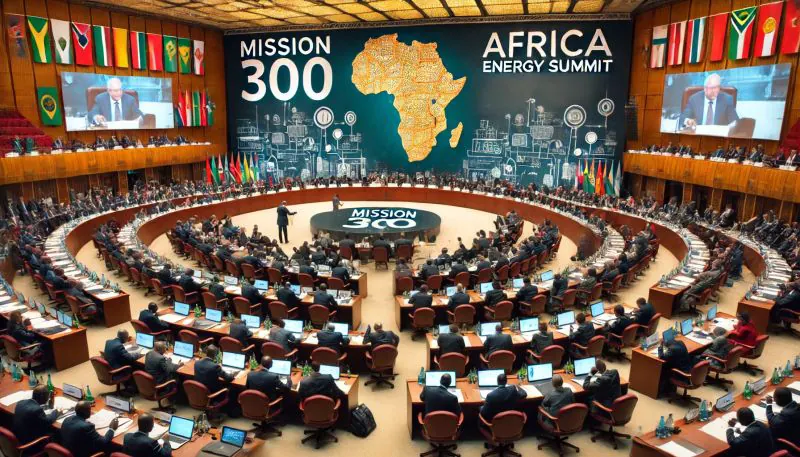
The World Bank Group and African Development Bank have made significant strides in increasing access to electricity in Africa, connecting a total of 64 million people to the power grid. This achievement is part of their joint Mission 300 initiative, which aims to deliver electricity to 300 million Africans by 2030. The initiative was launched in 2024 and has been backed by several partners, including the Rockefeller Foundation and the Global Energy Alliance for People and Planet.
According to Ajay Banga, President of the World Bank Group, the initiative has already made considerable progress, with 59 million people connected through the African Development Bank's efforts and an additional 5 million people connected through other means. The World Bank Group and African Development Bank are working together to reduce Africa's electricity-access deficit in half by 2030. The continent is home to nearly 600 million people without access to electricity, representing 83 per cent of the global deficit.
The joint initiative focuses on delivering household electricity connections through grid expansion, mini-grids, and standalone systems. The World Bank Group and African Development Bank are also working with governments, development partners, and private investors to achieve their goal. The institutions recognize that electricity is essential for hospitals, schools, agriculture, connectivity, and jobs, and are committed to accelerating their efforts to reach the 300 million target.
In addition to their work on electricity access, the World Bank Group is also making progress in other areas. The Bank's health work has reached more than 600 million people, with a goal of reaching 1.5 billion people by 2030 with improved access to primary healthcare. The Bank's Agriconnect initiative has also reached 26 million farmers, with an effort to connect them to scale.
The World Bank Group is also working to expand economic opportunities for women and women-led businesses. The Bank has provided capital and financial services to 17 million women and women-led businesses, and has provided broadband access to 74 million women. According to Ajay Banga, these efforts are part of a broader strategy to create jobs and promote economic growth.
Despite the progress made, the World Bank Group recognizes that there is still much work to be done. The Bank is pursuing more private capital to support its efforts, particularly in the poorest and most fragile countries. The Bank is also calling for more support from the private sector and philanthropic organizations, including replenishment of the International Development Association (IDA) fund.
On climate change, the World Bank Group delivered $96 billion in finance in 2025, with half mobilized from private capital. The Bank also mobilized $112 billion in 2025, more than triple the level four years ago. However, the flow of finance has stayed flat in the lowest-income countries, and the Bank has launched a new strategy targeting Micro, Small and Medium Enterprises (MSMEs).
Key points
- The World Bank Group and African Development Bank have connected 64 million people to electricity.
- The institutions aim to deliver electricity to 300 million Africans by 2030.
- The World Bank Group is also working to expand economic opportunities for women and women-led businesses.