A recent International Organization for Migration (IOM) climate vulnerability assessment report has found that women are emerging as the hardest-hit group in communities grappling with climate change and environmental degradation in Gambia. The report, published in August 2026, reveals that climate shocks are not affecting everyone equally, with women consistently identified as the most affected group in all nine focus group discussions conducted across the country.
According to the report, women's vulnerability is tied to their responsibility for household care, while simultaneously contributing to income generation and food production. This exposes them to both domestic and economic consequences of climate shocks. The assessment also found that women were identified as the most affected group in terms of access to food across all nine focus groups, with female-headed households repeatedly described as the households that recover most slowly following climate-related shocks.
The pressure comes at a time when food insecurity is already widespread in Gambia. Across the 102 assessed locations, 73 per cent reported that the majority of families do not have enough food. In Central River Region-North, the figure has risen to 100 per cent. The report attributes this to the deteriorating agricultural production, water availability, and household livelihoods.
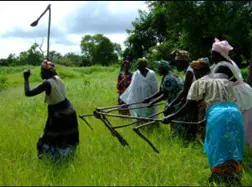
Women's economic coping mechanisms are also being disrupted, according to the report. The assessment found that women's savings and gardening groups can lose members, records, or shared infrastructure after climate shocks, weakening structures that provide income and social support. This has severe consequences for women, who rely heavily on these groups for financial stability.
Communities in Gambia are increasingly turning to difficult coping strategies, including sending household members elsewhere to seek alternative livelihoods, changing shelter types or building materials, conserving water, and working in exchange for food. The assessment found that 47 per cent of locations adopted coping or adaptation measures, with 46 per cent changing shelter types or building materials, and 44 per cent working in exchange for food.
The report also found that 31 per cent of locations that adopted coping mechanisms reported spending savings, while 20 per cent reduced meal sizes, and 5 per cent reported sending children to work. The findings suggest that women's vulnerability is tied not only to climate hazards themselves but also to their position within households and communities.
The IOM is calling for climate, livelihood, food-security, and recovery programmes to be designed to reach women and female-headed households directly. The assessment argues that gender-responsive programming is necessary because women carry a disproportionate share of the burden created by climate-related food shortages, care responsibilities, and loss of livelihoods.
Key points
- Women are disproportionately affected by climate change and environmental degradation in Gambia, with 73 per cent of assessed locations reporting food insecurity.
- Female-headed households are struggling to recover from climate-related shocks, with many unable to access food or secure livelihoods.
- The IOM is calling for gender-responsive programming to address the specific needs of women and female-headed households in Gambia.