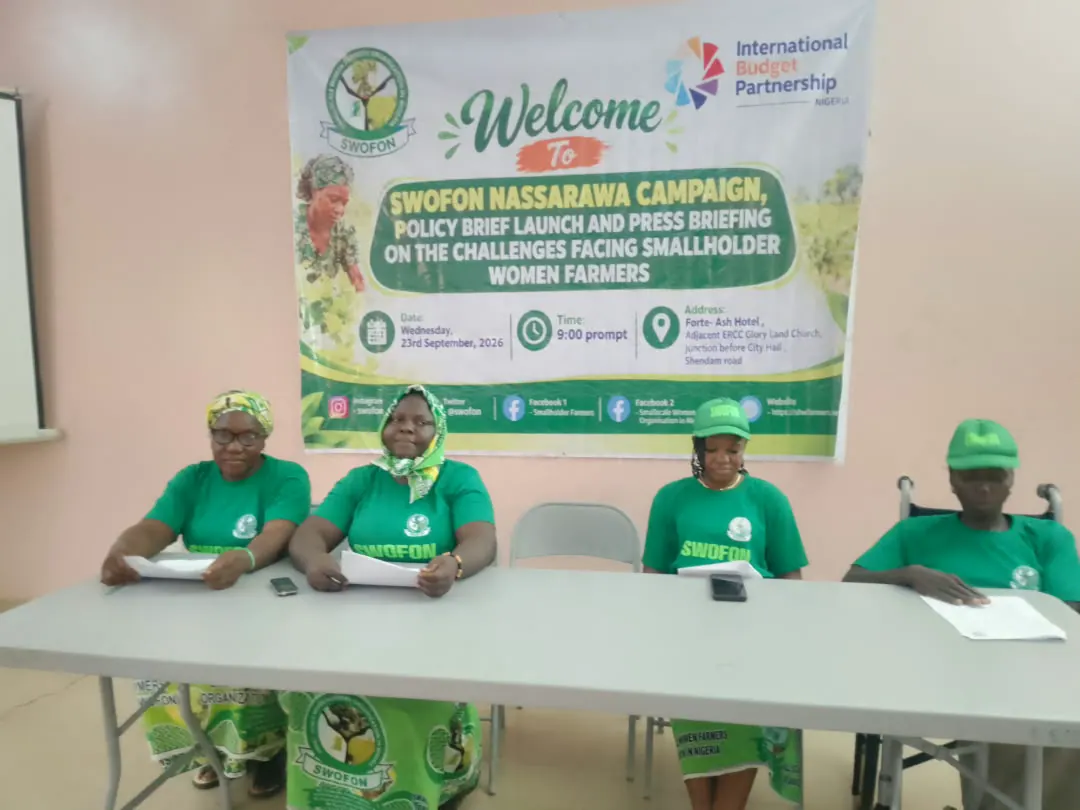
The Small-scale Women Farmers Organisation in Nigeria (SWOFON) Nasarawa State chapter has urged the state government to include a dedicated budgetary allocation for women farmers. This, they believe, will help address the specific constraints faced by women farmers, such as limited access to land, inputs, credit, and mechanization. According to Mrs. Jummai Yohana, the Nasarawa State coordinator of SWOFON, years of insignificant budgetary allocation for women in agriculture have resulted in poor yields and limited access to resources.
Mrs. Yohana explained that a gender-responsive agricultural budget is essential to identify how public resources address women farmers' specific constraints. She emphasized that the objective is not to create a separate agricultural system for women but to ensure that mainstream investments are accessible and beneficial to women farmers. To achieve this, SWOFON is advocating for institutionalized women's participation in state and local government budget hearings, with local government areas documenting women's priorities and providing formal responses.
The Nasarawa State government is urged to convert charter demands into costed budget commitments and review selected priorities annually with relevant Ministries, Departments, and Agencies. Additionally, the government is called upon to publish sufficient detailed information on agricultural allocations and expenditure to enable citizens to track programs and projects. This includes sex-disaggregated data on fertilizer distribution, grants, seedlings, mechanization, irrigation, credit, and equipment support.
Speaking during the briefing, Umar Jibril, the program manager of the Nasarawa State Agriculture Development Programme (NADP), attributed the lack of fertilizer distribution to some farmers in 2025 to the state's inability to provide fertilizer. He explained that the state government only distributed fertilizer donated by the Federal Government through the Federal Ministry of Agriculture and Food Security.
The SWOFON policy briefing provides a platform to advocate for inclusive solutions and ensure women's voices are included in policy discussions. Umar Jibril stressed that sustainable progress requires stronger implementation of existing policies and meaningful participation in decision-making. He also called on SWOFON to register their organization with existing associations to be incorporated in case of any distribution of farm inputs from the state government.
Mr. Ahmed Yakubu, Commissioner for Budget and Economic Planning, represented by Mr. Achiaku Ezekiel, described the national campaign on accelerating women farmers' impact towards food security as timely. He assured SWOFON that the Budget Department is ready to cooperate and encouraged the organization to engage directly with relevant MDAs under the agricultural sector.
The advocacy by SWOFON Nasarawa State chapter highlights the need for inclusive budgeting and policy implementation to support women farmers. Key to this is ensuring that women have access to resources, services, and decision-making processes that can enhance their productivity and contribution to food security in the state.
Key points
- Women farmers in Nasarawa State seek dedicated budget allocation to address their specific constraints and improve food security.
- A gender-responsive agricultural budget is crucial to identify and address women farmers' specific needs.
- Institutionalized women's participation in budget hearings and implementation is essential for effective policy execution.