For decades, financial exclusion has hindered rural women, smallholder farmers, and persons with disabilities in northern Nigeria. Despite their significant contributions to agriculture, food processing, and local commerce, many have operated outside the formal financial system. The Women Farmers Advancement Network (WOFAN) is addressing this issue with a financial inclusion model that prepares vulnerable producers to attract and manage larger pools of capital. Between 2025 and 2026, WOFAN disbursed N207.58 million to 147 women's cooperative clusters across six states.
WOFAN's approach starts with groups of about 30 people, focusing on savings, bookkeeping, and collective responsibility. Beneficiaries progress to larger financial support after demonstrating financial discipline. The organisation's model seeks to break the cycle of dependency on grants, positioning them as a test of whether beneficiaries can manage capital responsibly. This approach is crucial to understanding WOFAN's crowdfunding ambitions, as it creates the evidence required for beneficiaries to approach formal lenders or crowdfunding platforms.
The organisation's experience provides an interesting case study of community-based financing. WOFAN facilitated over 90,000 bank accounts for previously unbanked women and targets 12,750 persons with disabilities under the broader ICON2 programme. The programme has disbursed funds in three rounds, with N154.35 million going to all 147 clusters in the first round, N28.03 million to 33 clusters in the second round, and N25.20 million to 12 high-performing clusters in the third round.
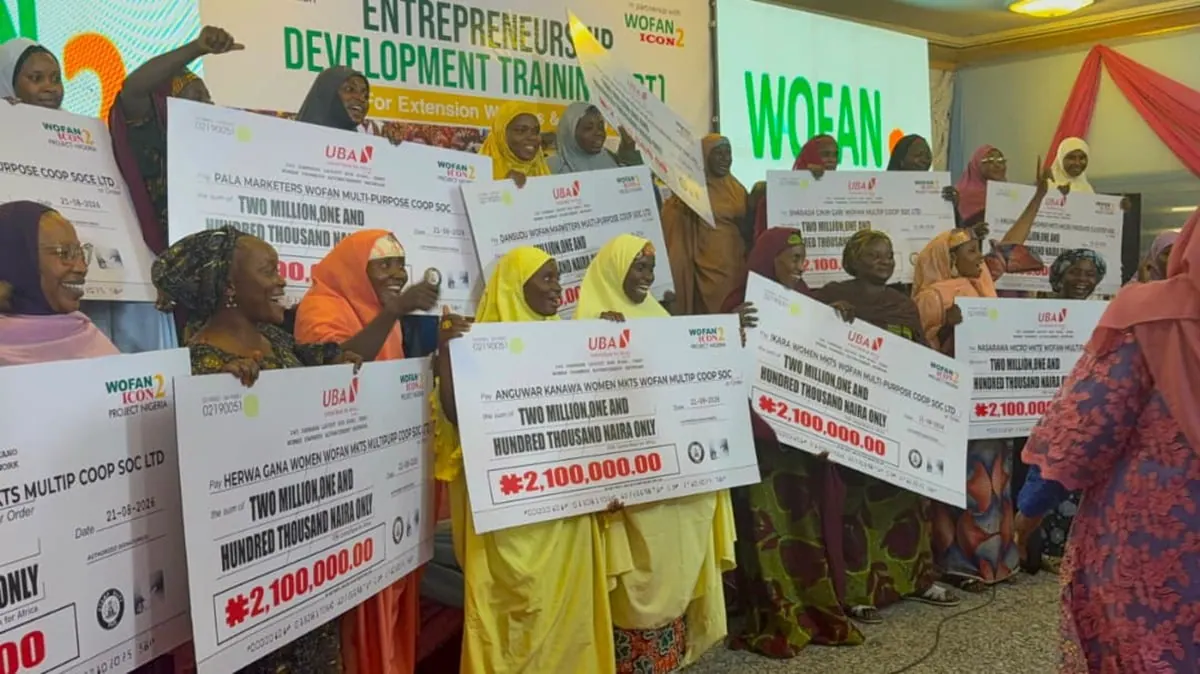
The 12 clusters that completed the three-stage process accumulated approximately N4.35 million each, representing a combined N49.3 million. On August 21, 2026, the 12 high-performing clusters received UBA presentation cheques of N2.1 million each, issued in the legal names of their cooperatives. This milestone symbolises a fundamental change in economic identity for the beneficiaries, who are no longer simply recipients of assistance but part of a financial institution's potential customer base.
WOFAN's strategy is designed around the proposition that beneficiaries who demonstrate the ability to manage grants can eventually manage loans. The organisation is preparing beneficiaries for crowdfunding and formal credit through training in business pitching, savings, bookkeeping, and financial management. This progression aims to create a pipeline of rural borrowers with records that banks and other financiers can assess.
Crowdfunding could provide rural enterprises with an alternative source of capital at a point where traditional bank lending may still be difficult to access. A successful crowdfunding campaign could provide market validation for an enterprise. WOFAN's current experience should be described as preparing beneficiaries for crowdfunding, rather than simply providing grants.
The model's sustainability will be tested as beneficiaries transition from grant recipients to investment-ready entrepreneurs. WOFAN's approach has the potential to create a bridge between informal economic activity and the formal financial sector, promoting financial inclusion and empowering women farmers in Nigeria. The organisation's experience offers valuable insights into community-based financing and the role of crowdfunding in rural development.
Key points
- WOFAN's financial inclusion model has disbursed N207.58 million to 147 women's cooperative clusters across six states.
- The organisation's approach prepares beneficiaries for crowdfunding and formal credit through training in business pitching, savings, bookkeeping, and financial management.
- The model's sustainability will be tested as beneficiaries transition from grant recipients to investment-ready entrepreneurs.