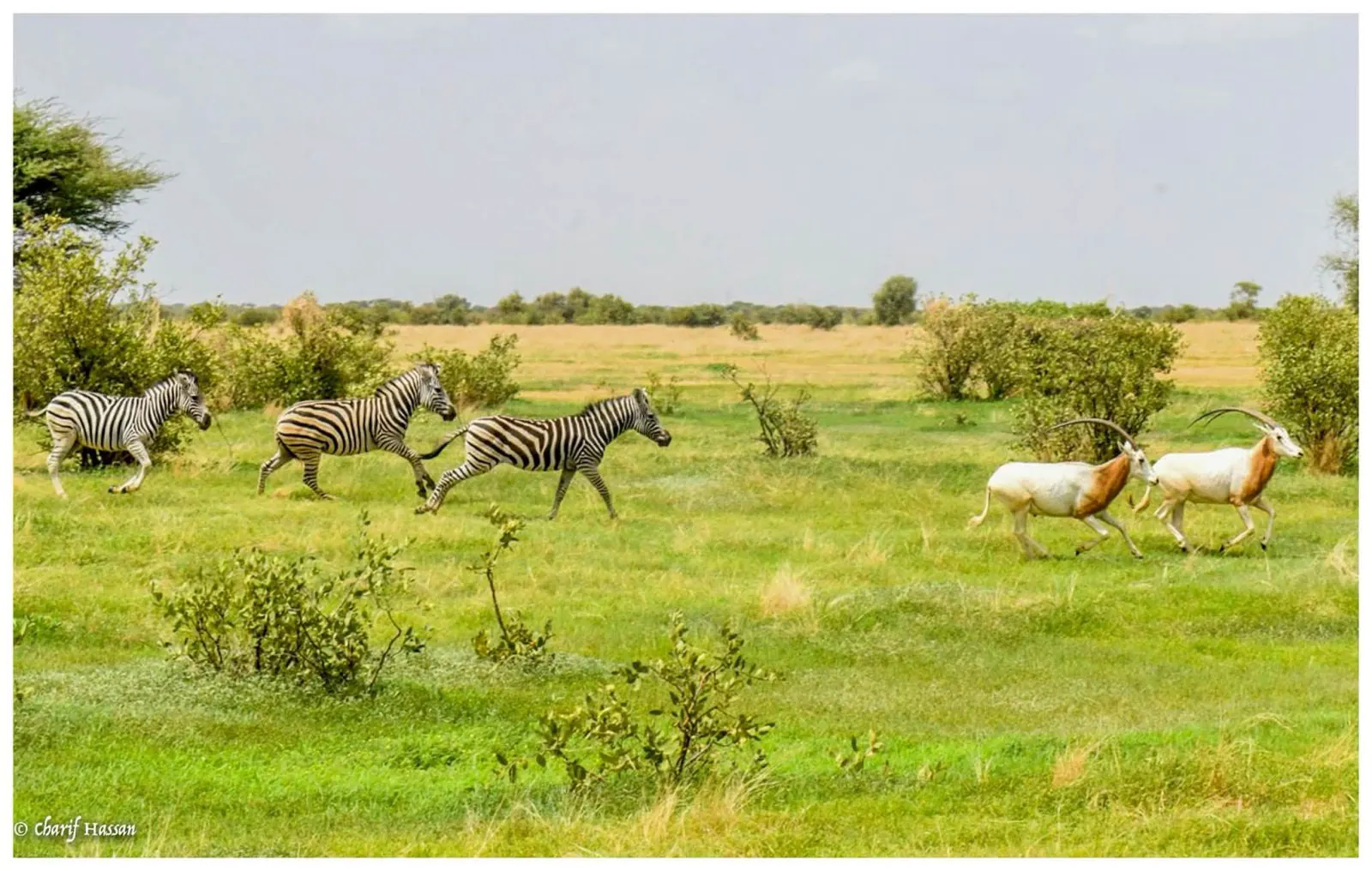
Located in the north of Senegal, in the Podor department, the Amboura wildlife reserve spans 1,050 hectares and was established in 2016 within a classified forest. The reserve's landscape transforms during the rainy season, with tall grasses and lush vegetation, and returns to a drier, more typical Sahel-like environment during the rest of the year. This varied vegetation is a result of conservation efforts, which have led to the regeneration of species such as acacias and balanites, contributing to soil stability.
The Amboura reserve operates on a simple principle: animals are neither enclosed nor fed by humans. Instead, they roam freely, seeking shade during hot hours and living at their own pace. The reserve is home to reintroduced species, including the oryx algazelle, which has become its emblem, as well as giraffes, zebras, gnus, and various other animals. These species coexist with local wildlife, such as phacochères, chacals, and patas monkeys. The reserve also provides a haven for birds, including threatened species like the great bustard.
The Amboura reserve is not a traditional zoo, and visitors are not guaranteed to see specific animals. However, the best time for a visit is during the morning, when the heat has not yet driven the wildlife into the shade. Visitors must accept that nature dictates the experience, which adds to the reserve's charm. The reserve engages with local communities by employing guards from nearby villages and providing them with access to a well for their livestock.
Since its establishment in 2016, the Amboura reserve has seen significant growth, particularly in its cervicapra population, which has increased from five to 122 individuals. The reserve's management aims to make Amboura a tourist destination by 2027, provided that the three kilometers of dirt road separating it from the national highway can be improved. Plans are underway to study the feasibility of building discreet, eco-friendly accommodations, similar to those found in East and Southern African safari camps.
One of the main challenges facing the Amboura reserve is accessibility. Currently, visitors must navigate a few kilometers of dirt road to reach the reserve, which has limited its popularity. However, with planned improvements to the access road and potential accommodations, the reserve hopes to attract more visitors and create jobs for local youth, including guides.
The Amboura reserve is not isolated from its surroundings. It provides benefits to local communities, including the supply of hay, which helps with vegetation regeneration. The reserve's management is optimistic about its future but acknowledges that a comprehensive evaluation of its success will only be possible in 10 to 15 years.
As the Amboura reserve continues to develop, it balances conservation and ecotourism goals. By protecting and showcasing Senegal's diverse wildlife, the reserve aims to contribute to the country's conservation efforts while promoting sustainable tourism practices. The reserve's progress will be closely watched, as it seeks to become a model for conservation and community engagement in West Africa.
Key points
- The Amboura wildlife reserve in Senegal is home to a diverse range of species, including giraffes, oryx, and zebras, living in freedom across its 1,050 hectares.
- The reserve, established in 2016, aims to become a tourist destination by 2027, with plans for improved access and eco-friendly accommodations.
- By balancing conservation and ecotourism, the Amboura reserve seeks to promote sustainable practices and community engagement in Senegal's Podor department.