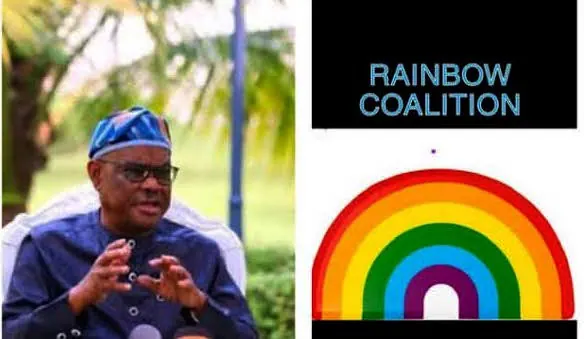
The 'Rainbow Coalition' initiative by Nyesom Wike has raised questions about its implications beyond Nigeria's 2027 presidential election. Wike's goal is to mobilize support across political parties for President Tinubu's re-election. The coalition allows politicians from different parties to support Tinubu without leaving their respective parties. Wike has stated that the coalition is not an APC structure and that parties remain free to field candidates for other elections.
The choice of the term "Rainbow" has prompted speculation due to its international association with diversity and inclusion, particularly with LGBT rights in Europe and Western societies. Critics argue that Wike's desperation to ensure Tinubu's re-election, despite the current hardship under his administration, may be driven by a desire to attract Western attention and influence. This has led to questions about Wike's motivations and the potential implications for Nigeria.
Wike's critics argue that his actions are driven by self-preservation, as he fears that a victory by opposition figures like Atiku Abubakar or Peter Obi would pose a danger to him personally and politically. There have been allegations of attempts to use the judiciary to frustrate opposition candidates and ensure Tinubu's candidacy. These developments have contributed to concerns about the country's democratic processes.
The Rainbow Coalition has been criticized as an "anti-Nigerian corps" by those who view it as an attempt to undermine the country's political system. Some interpret Wike's actions as an effort to win European governments' support for Tinubu's re-election, potentially at the cost of Nigeria's natural resources and solid minerals. This has sparked concerns about the country's history of colonialism and its implications for Nigeria's sovereignty.
Critics argue that Wike's courting of Western governments is aimed at ensuring that they do not monitor or issue adverse reports on alleged undemocratic activities and electoral violations during the 2027 elections. They contend that such foreign influence would be a troubling return to the era of colonial control. The situation has raised questions about the role of external influences in Nigeria's politics and the potential risks to its democratic development.
The controversy surrounding Wike's Rainbow Coalition has sparked a national debate about the country's political future and its relationships with external actors. As the 2027 presidential election approaches, Nigerians are closely watching the developments and their potential implications for the country's governance and sovereignty.
The situation remains uncertain, with many Nigerians expressing concerns about the potential risks and consequences of Wike's actions. As the country navigates its complex political landscape, the international community is also watching closely, aware of the potential implications for regional stability and global relations.
Key points
- Wike's Rainbow Coalition has sparked concerns about external influence in Nigeria's politics.
- The initiative has been criticized as an attempt to undermine the country's political system.
- The controversy has raised questions about Nigeria's sovereignty and its relationships with Western governments.