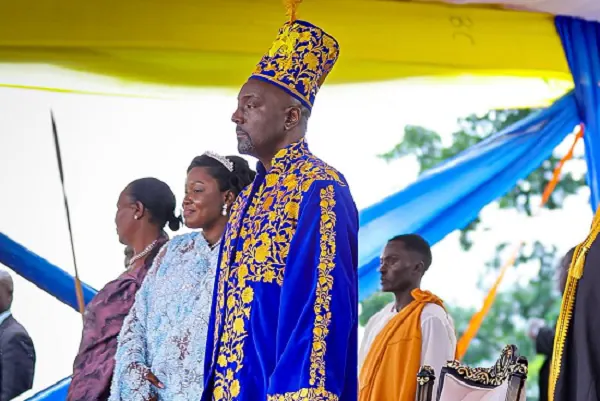
The Tooro Kingdom recently welcomed its 15th Omukama, Prince Edward Rukidi Kijanangoma, who ascended to the throne as Omukama Nyabongo I. This name choice has sparked curiosity among many Batooro and Ugandans. According to historian and journalist Wilson Akiiki Kaija, the name Nyabongo I reflects the historical relationship between Tooro and Bunyoro kingdoms. Tooro emerged from Bunyoro in the early 19th century after Crown Prince Kaboyo Olimi Kasunsunkwanzi rebelled against his father.
The historical connection between Tooro and Bunyoro is rooted in their shared royal family. Kaboyo, who became the first king of Tooro, was expected to succeed his father as ruler of Bunyoro but refused, leading to the establishment of a separate kingdom. His father then selected another son, Mugenyi, as his successor, who became Omukama Nyabongo II of Bunyoro. The name Nyabongo II was significant due to an earlier Bunyoro ruler with the same name. This historical context influenced the Tooro succession elders' decision when choosing a throne name for Prince Edward Rukidi Kijanangoma.
The succession committee considered several factors, including age, when selecting a throne name for Prince Edward Rukidi Kijanangoma. Mugenyi became king of Bunyoro at a mature age, and similarly, Prince Edward Kiijanangoma ascended to the throne at 56. The committee also noted that Mugenyi was remembered for his humility and obedience, qualities associated with Kiijanangoma. Furthermore, the circumstances surrounding Mugenyi's ascension to the throne, which involved his brother rejecting the opportunity to succeed their father, paralleled the recent Tooro succession process.
The selection process for the new king was thorough and involved a 21-member committee assessing potential candidates against five broad areas: social, cultural, economic, political, and cognitive qualities. The committee considered a candidate's roots in Tooro, character, reputation, public trust, knowledge of Tooro customs and traditions, self-sufficiency, and ability to work with the clan and the wider kingdom. Three candidates were shortlisted, and Prince Edward Rukidi Kiijanangoma emerged as the selected successor.
Prince Edward Rukidi Kiijanangoma was announced as the selected successor on September 9 at Karuziika Palace. The 56-year-old prince is a cousin of the late King Oyo and has worked as a journalist, news anchor, and editor at Uganda Broadcasting Corporation. The committee emphasized that he did not use his media career to campaign for the throne. The transition from Prince Edward Rukidi Kiijanangoma to Omukama Nyabongo I marks a new chapter in the royal naming tradition.
The new Omukama inherits a kingdom in transition, with challenges including building reconciliation within the royal family and the wider Babiito clan. He will also face the task of preserving Tooro's cultural identity while connecting it to a younger generation and Batooro living outside Uganda. Economically, the monarchy is expected to contribute to tourism, livelihoods, and opportunities for ordinary people. The king will need to work with the kingdom's institutions, clans, and the Ugandan state while maintaining Tooro's cultural identity.
The decision to call the new king Nyabongo I carries historical and symbolic meaning, reflecting the qualities that the elders saw in Prince Edward Rukidi Kiijanangoma. The name choice opens a new chapter in the royal naming tradition, which has evolved alongside the history of Tooro. On September 12, during the burial of King Oyo at the Karambi Royal Tombs, Kiijanangoma performed the Iziba rite, symbolizing the physical handover of power. The Tooro Kingdom Supreme Council unanimously endorsed him on September 15.
Key points
- The historical relationship between Tooro and Bunyoro influenced the choice of the name Nyabongo I for the new king.
- The succession committee considered several factors, including age and qualities, when selecting a throne name for Prince Edward Rukidi Kijanangoma.
- The new Omukama inherits a kingdom in transition, with challenges including building reconciliation and preserving Tooro's cultural identity.