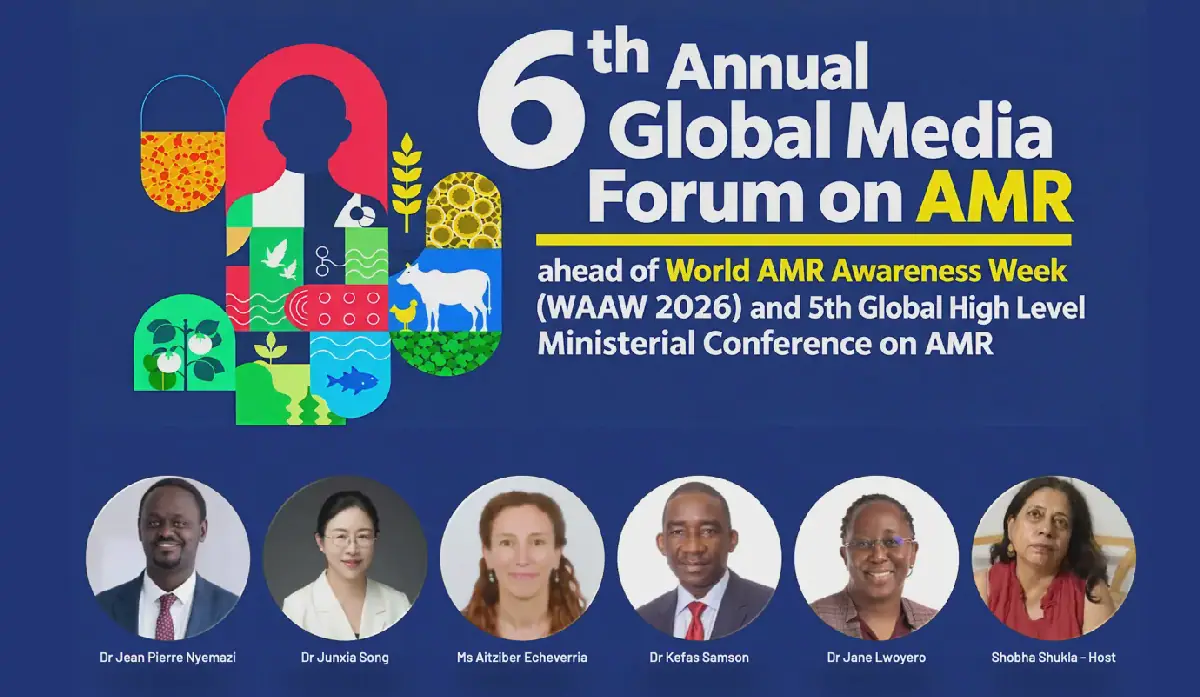
The World Health Organisation (WHO) has emphasised the need for countries to translate global commitments to tackle antimicrobial resistance (AMR) into concrete action. According to WHO, AMR is one of the most urgent global health threats and development challenges, threatening the ability to treat infections, protect animal and plant health, and produce safe food. The organisation warned that inadequate financing, weak surveillance and poor coordination continue to undermine progress.
The call for action comes as the world prepares to mark World AMR Awareness Week (WAAW) from 18 to 24 November. The theme of this year's awareness week is "One Health, One Action: Prevent AMR Now". WHO's Director a.i. (ad interim) of WHO's Department of Antimicrobial Resistance, Jean-Pierre Nyemazi, stressed the need to move beyond global commitments to practical action. He noted that the gap between commitments and pledges versus implementation remains wide.
At the 2024 United Nations General Assembly High-Level Meeting on AMR, world leaders adopted a political declaration committing to reduce deaths from bacterial AMR by 10 per cent by 2030, from a 2019 baseline of 4.95 million. They also pledged to ensure that at least 60 per cent of countries have funded national AMR action plans by 2030 and called for at least $100 million in catalytic funding. WHO's Senior Technical Officer and Lead of Multisectoral Coordination in its AMR Department, Kefas Samson, identified inadequate financing, gaps in surveillance of antimicrobial resistance and use, weak infection prevention in healthcare facilities, limited diagnostic capacity and unequal access to quality-assured medicines as major challenges.
WHO is supporting governments to assess their needs, cost interventions and adapt their plans to local circumstances and available resources. The organisation is also strengthening surveillance to track implementation of the updated Global Action Plan on AMR for 2026–2036 and measure progress towards the 2030 targets. Other targets include ensuring that 70 per cent of antibiotics used in human health belong to WHO's Access group, which comprises antibiotics recommended for first- and second-choice treatment of common infections.
The Food and Agriculture Organisation of the United Nations (FAO) warned that failure to improve animal health and farming practices could further increase antimicrobial use. Global antibiotic use in livestock could rise by nearly 30 per cent by 2040 without intervention. However, improved animal health and farm management practices could reduce antibiotic use by up to 57 per cent. The United Nations Environment Programme (UNEP) also warned that environmental pollution could undermine efforts to contain AMR.
The environment plays a role in the emergence, transmission and spread of drug-resistant microorganisms. Pharmaceutical manufacturing, agriculture and food systems, healthcare, and municipal waste and wastewater management are priority areas requiring intervention. The World Organisation for Animal Health (WOAH) reported that global antimicrobial use in animals declined by three per cent between 2019 and 2024. The organisation also reported that 74 per cent of countries did not use antimicrobials for growth promotion.
Nigeria is expected to host the fifth Global High-Level Ministerial Conference on AMR in Abuja from 6 to 8 December. The meeting is expected to review progress, address implementation challenges and renew political commitment to tackling AMR. The updated Global Action Plan for 2026–2036 and the proposed Independent Panel on Evidence for Action against AMR are also expected to feature in discussions.
Key points
- The World Health Organisation has called for concrete action to tackle antimicrobial resistance worldwide, citing 4.7 million deaths in 2021.
- Inadequate financing, weak surveillance and poor coordination continue to undermine progress in tackling antimicrobial resistance.
- The fifth Global High-Level Ministerial Conference on AMR will be held in Abuja from 6 to 8 December to review progress and renew political commitment to tackling AMR.
Reporting sources
- WHO urges concrete action on antimicrobial resistance worldwide · Premium Times