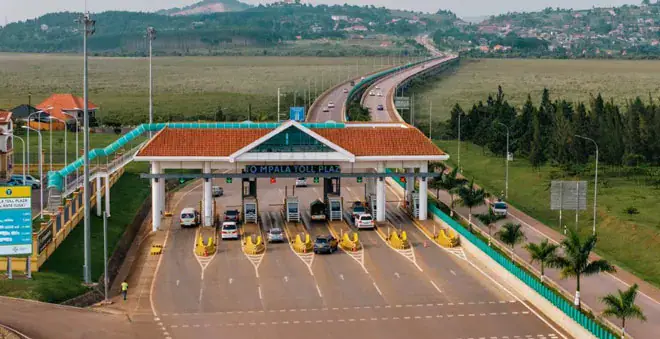
China's Export-Import Bank (Exim Bank) has become one of Uganda's most consequential infrastructure financiers, backing major projects across the country's transport, energy, and oil sectors. The Kampala–Entebbe Expressway, a 56-kilometre road connecting the outskirts of Kampala to Entebbe International Airport, is one of the most visible investments. Since opening in August 2018, the expressway has cut travel time to about 40 minutes under normal traffic conditions.
The Kampala–Entebbe Expressway project loan cost approximately $476 million, with Exim Bank providing $350 million, about 73% of the total cost. The Ugandan government financed the balance. Although described as the world's most expensive road, comparisons with roads in Kenya and other countries show that this claim may not hold when factoring in project scope, engineering specifications, and included costs.
Exim Bank has also financed two of Uganda's major hydropower projects: $1.4 billion for the 600MW Karuma hydropower plant and $482 million for the 183MW Isimba dam. The latter covered approximately 85% of the project's cost. These investments raise questions about the economic value gained by Uganda and how returns compare with attached financial obligations.
Beyond roads and power generation, Exim Bank has financed projects spanning Uganda's aviation, oil, telecommunications, and rural electrification sectors. Investments have targeted some of the country's most important development constraints, including inadequate transport infrastructure, unreliable electricity supply, limited digital connectivity, and high transport costs.
Karuma was commissioned in September 2024, adding 600MW to the national generation system and taking Uganda's generation capacity to slightly above 2,000MW. These investments have expanded the country's ability to generate electricity, support industrial production, and potentially export power to neighbouring countries. However, increased generation capacity does not automatically translate into affordable electricity or universal access.
Exim Bank provided approximately $200 million towards the expansion of Entebbe International Airport, modernising Uganda's principal international gateway and improving passenger and cargo-handling capacity. The bank has also financed roads in the oil-producing Albertine region and Phase V of Uganda's National Backbone Infrastructure, a project valued at approximately $150 million, extending optical fibre across 63 additional districts.
A 2021 study published in the journal Sustainability concluded that Uganda had generally benefited from Chinese-funded infrastructure, challenging the notion that such lending amounts to a debt trap. However, concerns were highlighted over transparency, local business participation, employment, environmental and social safeguards, displacement, and the distribution of project benefits.
Key points
- Exim Bank's financing model is tied to the use of Chinese contractors, equipment, technology, and services.
- The Kampala–Entebbe Expressway generates an average of Shs3.5 billion in monthly toll revenue.
- Exim Bank has financed major projects worth billions of dollars in Uganda's infrastructure sectors.