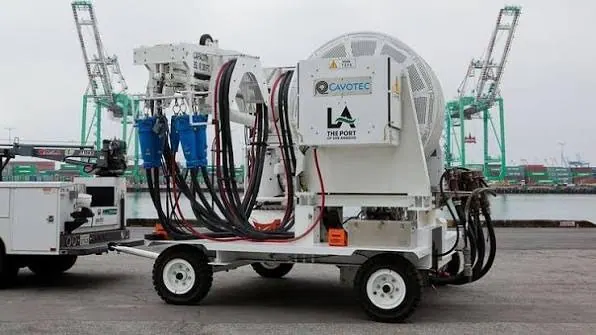
The maritime industry is shifting towards cleaner operations, with shore power emerging as a key component. Shore power allows vessels at berth to switch off diesel generators and connect to shore electricity, reducing emissions and fuel consumption. This technology has been used for decades but is becoming mainstream in European ports. Recent developments in Europe indicate a growing trend towards shore power infrastructure.
In January 2026, ABB was selected to build and maintain shore-power infrastructure at the Port of Rotterdam. The project covers approximately eight kilometers of berth with 35 connection points and over 100 MVA of power capacity. Financing includes a €90 million European Investment Bank loan and €70 million in European Commission grants. The Port of Los Angeles also provides a useful reference, with shore-power infrastructure covering all container and cruise berths.
European regulations require shore-side electricity infrastructure at major ports from 2030, extending to large container and passenger vessels by 2035. Shipping companies serving European routes are equipping vessels to connect to shore power, which has implications for West African ports. Vessels equipped to use shore power can use it at any port, but West African ports lack compatible infrastructure.
This creates an infrastructure-planning question for West African ports: when should shore-power readiness become part of port development? Nigeria has significant long-term relevance due to vessel traffic and container activity, but grid capacity and reliability make a selective berth-level pilot more practical. Tema and Abidjan are also candidates for early feasibility assessments.
Banjul presents a different opportunity, with the port undergoing modernization and expansion. Basic provisions for future shore power can be incorporated into the construction program, even if the complete system is not installed immediately. Being shore-power ready does not mean committing to a major electrical installation but ensuring that today's construction decisions do not make tomorrow's installation difficult or expensive.
A digital component is also crucial, as shore power requires coordination of vessel arrival, berth allocation, connection requests, energy consumption, billing, and emissions reporting. As African ports become more digital, these functions can be integrated with existing port operating systems. Companies like WATT can contribute to the digital coordination layer without owning the physical energy infrastructure.
Ports should not adopt shore power simply because it's a trend; a proper feasibility assessment is necessary. Factors to consider include vessel traffic, berth utilization, vessel compatibility, electricity demand, grid reliability, tariffs, and backup power costs. The commercial model also matters, with options including concessions, energy-as-a-service arrangements, or wider port modernization projects.
Key points
- West African ports must plan for shore power infrastructure to stay competitive.
- Nigeria, Tema, and Abidjan are potential candidates for early shore power feasibility assessments.
- Shore power readiness can be incorporated into port modernization and expansion projects.